
Smart hypertrophy: how many sets, reps and how much rest do you really need?
Weekly volume, effort, frequency and progression: build an efficient training plan with four example sessions and evidence-informed decisions.

Imagine two intermediate lifters. One piles up 24 chest sets, shortens rest and reaches failure almost everywhere. The other uses fewer exercises, records performance and increases demand when ready. This description cannot predict who will grow more. Yet the second plan makes a key principle explicit: balance stimulus, performance and recovery.
1. What actually drives hypertrophy?
Hypertrophy is an increase in muscle-fiber size over time. Resistance training creates mechanical tension and triggers adaptation. Load, effort, technique and exercise choice shape the stimulus. Soreness, a pump and fatigue do not measure growth: productive training need not leave you exhausted, and severe soreness does not establish that a session was optimal.
2. How many weekly sets?
Pelland and colleagues pooled 67 studies and 2,058 participants, published online in 2025 and in a 2026 issue. More volume was associated with greater hypertrophy, with diminishing returns. The study did not establish one ideal number for everyone. If ten sets already produce progress, doubling them is not mandatory. Extra work also costs time and recovery.[1]
| Profile | Illustrative starting point per muscle/week | Priority |
|---|---|---|
| Beginner | 4–8 sets | Learn technique and tolerate training |
| Intermediate | 8–14 sets | Consistency and progression |
| Advanced | 10–20 sets, according to need | Individualize and manage fatigue |
These ranges are programming choices, not thresholds established by the meta-analysis. Warm-ups and easy sets need not count as hard working sets. Runners, grapplers and cyclists should consider total demand; advanced experience does not automatically require high volume.
3. Direct and indirect sets are not identical
Bench pressing trains the chest and triceps, but not identically. In Pelland’s fractional model, indirect sets received partial weight; that model fit the data better. This does not make every indirect set exactly half a set. Consider the context: substantial pressing may reduce the need for additional triceps work.[1]
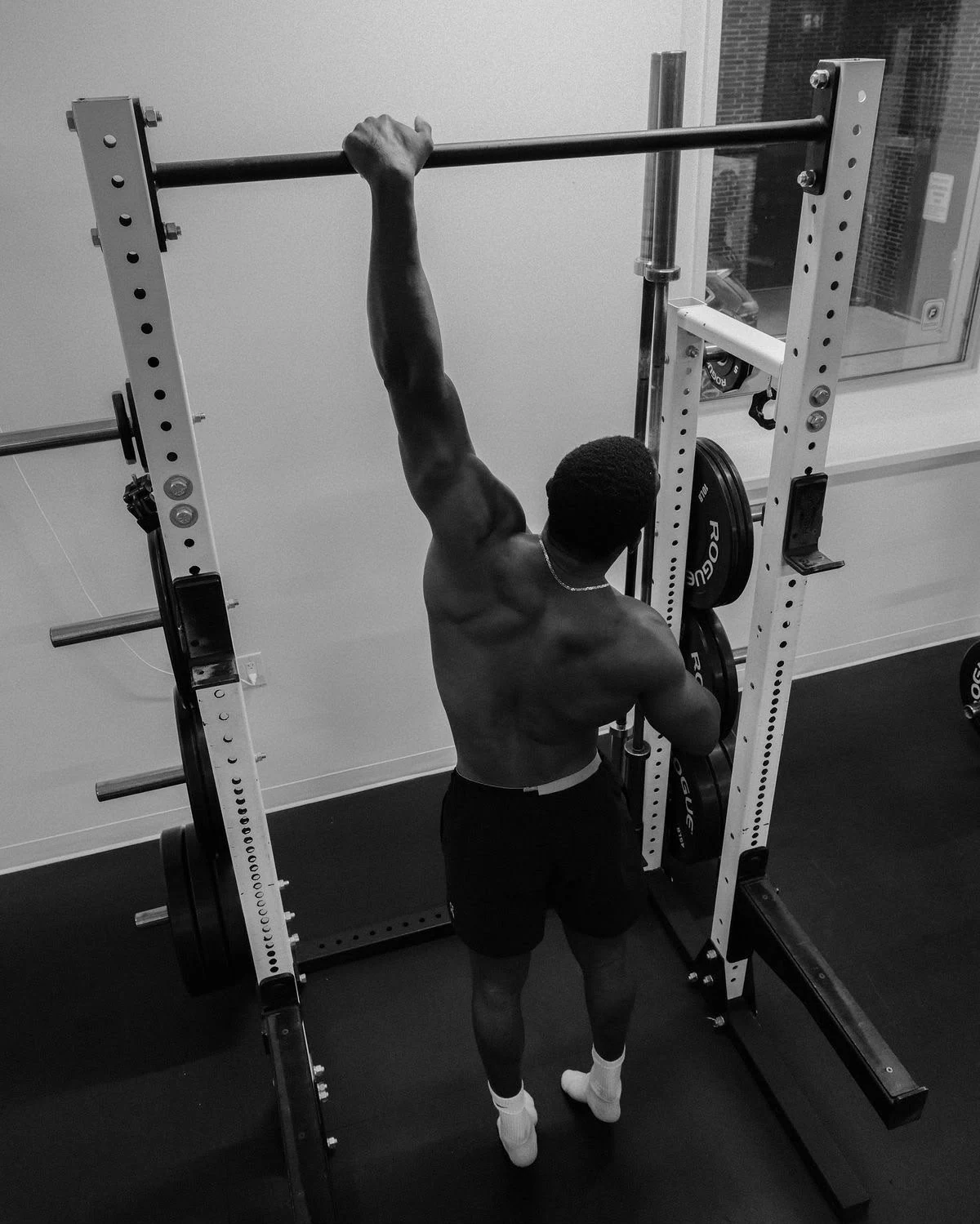
4. Muscle failure, RIR and effort
Failure means being unable to complete another repetition with the specified technique despite trying. RIR estimates remaining repetitions: RIR 3 means about three; RIR 1, one; RIR 0, none. It is subjective and takes practice. Stopping because of imbalance or discomfort does not necessarily mean the target muscle reached failure.
Robinson and colleagues found an association between training closer to failure and hypertrophy, but RIR was estimated from study protocols. This does not identify a universally optimal RIR. A practical reference of 1–3 repetitions in reserve can organize many sets. Use failure strategically: an isolation machine and a heavy free-weight squat have different technical costs.[2]
How much did you have left?
Select an RIR estimate to understand the effort of a set.
Two repetitions in reserve
You finish the set estimating that you could do two more repetitions. The effort is substantial, with a small margin before your limit.
Approximate relationship on the RIR-based RPE scale for resistance training. This is not an exact measurement or a claim that one level is best for everyone.
5. Which repetition range is best?
Currier’s network review included 119 studies and 3,364 participants in its hypertrophy analysis. Different prescriptions produced growth; heavier loads showed more consistent advantages for maximal strength. For hypertrophy, choose ranges that allow appropriate effort and technique without disproportionate discomfort. Very long sets may become limited by breathing before the target muscle.[3]
| Repetitions | Practical use |
|---|---|
| 3–5 | Strength emphasis; hypertrophy is also possible |
| 6–10 | Strength and hypertrophy in compound exercises |
| 10–15 | Practical range for many exercises |
| 15–25 | Useful option; monitor discomfort and duration |
6. Rest: recover to maintain quality
Singer and colleagues analyzed nine studies and suggested a small advantage for rests longer than 60 seconds, without clear differences beyond 90 seconds and with meaningful uncertainty. This does not prove 90 seconds is sufficient everywhere. As a practical application, start with 2–3 minutes for demanding compound lifts and 60–120 seconds for isolation work, adjusting to preserve technique and repetitions.[4]
If bench-press performance drops from ten to six to four repetitions after thirty-second rests, reconsider the interval before adding sets. More fatigue does not automatically mean a better stimulus. Recover enough for the next set’s purpose without making the timer a rigid rule.

7. Frequency: distribute the volume
After accounting for volume, frequency’s additional effect on hypertrophy is less clear than on strength. Splitting twelve sets into two sessions of six may help quality and recovery without guaranteeing more growth. Beginners can use two or three full-body sessions; intermediates can alternate upper and lower body. Choose a split that fits your routine.[1]
8. Full range or lengthened partials?
Varovic’s review pooled twelve studies on muscle length and regional hypertrophy. Overall differences were small and comparisons had limitations. This does not establish universal superiority of lengthened partials. Use a controlled range that suits your anatomy and feels comfortable. An interesting strategy can complement training without automatically replacing everything that works.[5]
9. Double progression: when to add weight
Set three sets of 8–12 repetitions. With the same load and technique, progress from 10/9/8 to 12/12/12 across sessions while maintaining planned effort. Then consider a small load increase; repetitions may return to the bottom of the range. This is an example, not a deadline. Do not force increases if the available jump is too large or technique deteriorates.
3 sets. An 8–12 rep range.
Follow an example of double progression: first repetitions, then load.
Start by recording what you can do with consistent technique and the planned effort.
An illustrative example, with no guaranteed timeline. A stage can take several sessions. Maintain your technique and planned effort before increasing the load.
10. Four example sessions
For a healthy intermediate, this week places upper-body sessions on Monday and Thursday and lower-body sessions on Tuesday and Friday. Begin with a brief general warm-up and specific preparation sets, not counted as working sets. Keep approximately 1–3 repetitions in reserve. Allow about 50–75 minutes including warm-up, rests and transitions; adapt volume, exercises and time to your capacity.
Monday — Upper A · 16 sets
| Exercise | Sets | Repetitions | Rest |
|---|---|---|---|
| Flat bench press | 3 | 6–10 | 2–3 min |
| Seated row | 3 | 8–12 | 2 min |
| Shoulder press | 2 | 8–12 | 2 min |
| Lat pulldown | 2 | 8–12 | 90–120 s |
| Lateral raise | 2 | 12–20 | 60–90 s |
| Triceps pushdown | 2 | 10–15 | 60–90 s |
| Biceps curl | 2 | 10–15 | 60–90 s |
Tuesday — Lower A · 13 sets
| Exercise | Sets | Repetitions | Rest |
|---|---|---|---|
| Squat | 3 | 6–10 | 2–3 min |
| Romanian deadlift | 3 | 6–10 | 2–3 min |
| Lunge | 2 | 8 per leg | 90–120 s |
| Leg curl | 2 | 10–15 | 90 s |
| Standing calf raise | 3 | 10–15 | 60–90 s |

Thursday — Upper B · 16 sets
| Exercise | Sets | Repetitions | Rest |
|---|---|---|---|
| Incline bench press | 3 | 8–12 | 2 min |
| Lat pulldown | 3 | 8–12 | 2 min |
| Machine chest fly | 2 | 10–15 | 90 s |
| Seated row | 2 | 8–12 | 2 min |
| Lateral raise | 2 | 12–20 | 60–90 s |
| Triceps pushdown | 2 | 10–15 | 60–90 s |
| Biceps curl | 2 | 10–15 | 60–90 s |
Friday — Lower B · 13 sets
| Exercise | Sets | Repetitions | Rest |
|---|---|---|---|
| Leg press | 3 | 10–15 | 2 min |
| Hip thrust | 2 | 8–12 | 2 min |
| Leg extension | 2 | 12–15 | 90 s |
| Seated leg curl | 3 | 10–15 | 90 s |
| Seated calf raise | 3 | 10–15 | 60–90 s |
Totals refer to the entire session, not each muscle. Wednesday and the weekend can accommodate recovery and other activities according to demand. This plan has not been shown superior to other splits. If you do not yet tolerate this amount, reduce exercises or sets; machines and free weights are tools chosen for availability, comfort and purpose.
11. Adapt to experience and available time
Level is not determined by years in the gym alone. Consistency, skill and history matter. Beginners need learning and repetition; intermediates may distribute more work; advanced lifters need individualized priorities. With forty minutes, preserve the most important exercises and adequate rest. A short session need not become an intense circuit or require advanced techniques.
12. Eight weeks to observe and adjust
| Weeks | Priority |
|---|---|
| 1–2 | Establish loads, technique and RIR |
| 3–4 | Consolidate repetitions and consistency |
| 5–6 | Increase load or volume only when justified |
| 7–8 | Compare performance and review priorities |
The calendar does not force a volume increase in week five or a load reduction in week eight. Persistent performance decline, greater effort at familiar loads and poor recovery justify reviewing training, sleep, nutrition and stress. One bad week does not diagnose overtraining. Watch trends and consider a temporary reduction in demand when needed.

13. Protein, energy and supplements
Morton and colleagues pooled 49 studies and 1,863 participants. Average additional benefit from protein stopped clearly increasing around 1.6 g/kg/day; this is a statistical estimate, not an exact individual threshold. For 75 kg, that reference equals 120 g daily. Regular food can meet needs; supplements are convenient, not required. Insufficient energy can hinder adaptation, while a large surplus can increase fat.[6]
14. Hypertrophy and cardio can coexist
Running, cycling and lifting share available recovery. A hard run can impair the next leg session, just as demanding squats can affect the next run. Organize the week around your priority, protect key sessions and adjust volume and intensity. Cardio has its own value for health and fitness; it need not be punishment for eating.
15. Measure progress without confusing signals
More load or repetitions indicate performance, not muscle size directly. Body weight includes water, glycogen, fat and gut contents; measurements and photos also depend on conditions. Compare records, circumferences and standardized photos over weeks and months. Body-composition methods estimate tissues differently; ultrasound needs appropriate technique. No single indicator confirms how much muscle you gained.
16. Seven mistakes that limit hypertrophy
- Adding exercises before assessing current progression.
- Seeking absolute failure on every set.
- Shortening rest only to feel more fatigue.
- Changing the program every week and losing comparability.
- Copying professional athletes without considering context.
- Confusing soreness with growth.
- Increasing volume without accounting for recovery and other sports.
17. Where VETOR fits into this process
Two users may seek hypertrophy yet need different programs. VETOR’s approach connects goals, availability, sports, prescription, progression and history. When recorded, loads, sets and repetitions help inform decisions. This does not amount to directly measuring muscle growth or detecting failure through sensors. Missing information must remain unknown, and each adjustment should have a purpose.
18. What science does not yet settle
There is no perfect volume, RIR or rest interval for everyone. Studies vary in duration, methods and participants; many involve young adults, and Pelland’s sample was predominantly male. This guide’s examples apply principles rather than reproduce a proven superior protocol. Let evidence guide decisions, assess individual response and remain consistent long enough to observe results.[1]
VETOR — DON’T GUESS.
Give your next workout direction. Join the waitlist and follow VETOR.
References
- Volume, frequency and diminishing returnsPelland et al. (2026) · Sports Medicine · 56(2):481–505
- Proximity to failure and adaptationsRobinson et al. (2024) · Sports Medicine · 54(9):2209–2231
- Strength and hypertrophy prescriptionCurrier et al. (2023) · British Journal of Sports Medicine · 57(18):1211–1220
- Rest intervals and hypertrophySinger et al. (2024) · Frontiers in Sports and Active Living · 6:1429789
- Muscle length and regional hypertrophyVarovic et al. (2025) · International Journal of Sports Medicine · 46(14):1027–1036
- Protein and resistance-training adaptationsMorton et al. (2018) · British Journal of Sports Medicine · 52(6):376–384
Educational content for healthy adults. Examples do not replace assessment, individualized prescription or nutritional guidance. Adapt training to your history and seek advice for persistent pain.