
High-performance cycling: how to ride faster, build endurance and improve your power
Riding more kilometres does not guarantee progress. Learn to combine aerobic training, intervals, strength work and recovery, with sample sessions and a training week.
Why riding more does not always mean riding better
Imagine two cyclists who train four times a week. One repeats the same route and only increases the distance: 20, 30, then 40 kilometres. The other schedules sessions with different purposes: endurance, hard efforts, power and strength, allowing time for recovery. We cannot predict who will improve more, but the second programme addresses several abilities that matter for performance.
Cove and colleagues pooled 41 studies involving 797 trained cyclists. The meta-analysis found improvements with structured training, without statistically significant superiority of polarized training over other models. Longer interventions were associated with greater adaptations; weekly volume alone did not explain the differences. This does not make volume irrelevant: duration, distribution and context need to be interpreted together.[1]
1. What determines cycling performance?
Aerobic capacity, power, efficiency, fatigue resistance and strength interact with aerodynamics, wind, terrain and rolling resistance. The aerobic system supports long rides and recovery between accelerations. Power is work per unit of time, usually expressed in watts. More watts do not guarantee more speed on every route. Efficiency describes the metabolic energy needed to produce mechanical work: two riders can generate the same power at different physiological costs.
A short race, a 100-kilometre ride and a mountain-bike event require different combinations of these abilities. Preparation should start with the demands of the activity and your current capacity, not a single metric.
2. Aerobic training and Zone 2
Easy sessions let you accumulate training time without the recovery demands of hard sessions. A comfortable 60-minute ride does not need a finishing sprint or an acceleration on every climb. Its purpose is sustained effort and tolerance of prolonged exercise. Zone 2 does not mean the same thing in every system: three-, five- and seven-zone models use different references. Below the first threshold, speaking in full sentences can be a practical guide, without replacing physiological testing.
A review of 14 studies in endurance athletes reported favourable VO₂max and economy outcomes with polarized training, while noting limitations in the evidence. It does not establish a universal distribution or make every moderate session inappropriate.[3]
3. Intervals: quality before exhaustion
HIIT alternates demanding work and recovery. A review in trained cyclists found small average benefits in physiological and performance measures compared with easy or moderate continuous training. Interval duration and type alone did not explain the whole response. The examples below are educational models for healthy adults with suitable experience; doses need adjustment. Outdoors, traffic, corners and terrain also determine where hard efforts are safe.[2]
| Step | Prescription | Intensity |
|---|---|---|
| Warm-up | 10 min | Easy |
| Preparation | 5 min | Progressive |
| Main set | 5 × 3 min | Hard, controlled |
| Recovery | 4 × 3 min | Easy |
| Cool-down | 10 min | Easy |
Total: 52 minutes, counting four recoveries between five intervals. Start at a demanding effort, around 8–9 on a 0–10 scale, but controlled enough to complete every repetition. This is a subjective guide, not a universal measure of intensity. If technique or consistency deteriorates, adjust the session; do not chase exhaustion.
4. Power and FTP: interpreting watts
Average speed changes with wind, gradient and route conditions. FTP estimates sustainable power during a prolonged effort near the functional performance limit; it is not an exact laboratory measure of lactate threshold or maximal metabolic steady state. Different protocols can give different estimates. Prescribing 250 watts to someone with an FTP of 180 watts is not the same effort as prescribing it to someone with an FTP of 280 watts.
Without a power meter, use perceived effort, heart rate and standardized tests. Heart rate responds slowly to sudden changes; perceived effort changes with sleep, fatigue and heat. Compare similar conditions and consider trends rather than one isolated number.
5. Strength training for cyclists
A meta-analysis of 17 studies involving 262 cyclists found benefits of heavy strength training for efficiency, anaerobic power and performance, without significant improvement in VO₂max. Certainty was low: an ideal dose for everyone cannot be established. The paper appeared online in 2025 and in the January 2026 issue. Loads of at least 80% of one-repetition maximum were studied, but beginners should not automatically start at that level.[4]
| Exercise | Sets | Repetitions | Rest |
|---|---|---|---|
| Squat | 3 | 5–6 | 2–3 min |
| Romanian deadlift | 3 | 6–8 | 2 min |
| Split squat | 2 | 8 per leg | 90 s |
| Row | 3 | 8–10 | 90 s |
| Plank | 3 | 30–40 s | 60 s |
This illustrative session combines leg, hip, trunk and upper-body strength. Calf exercises can also be included when relevant. Not every movement is mandatory: adjust exercises, loads and volume to experience, limitations and the cycling week. Strength work should complement preparation rather than unnecessarily compromise an important ride.
6. A week with clear objectives
| Day | Training | Goal |
|---|---|---|
| Monday | Resistance training | General strength |
| Tuesday | Cycling intervals | Cardiorespiratory fitness |
| Wednesday | Recovery | Fatigue management |
| Thursday | Aerobic cycling | Aerobic cycling endurance |
| Friday | Resistance training | Complementary strength |
| Saturday | Long ride | Long-duration endurance |
| Sunday | Rest | Recovery |
This example is for an intermediate rider with three cycling and two strength sessions; it is not a mandatory routine. If Monday strength work compromises Tuesday intervals, or Friday lifting affects Saturday riding, reduce the dose or rearrange the days. A muscle-damage meta-analysis found reduced maximal power in some tasks and greater perceived effort during submaximal work, but not every measure worsened. Total load and recovery matter as much as each session.[5]
7. Three sessions for different abilities
Session A — Aerobic base: 40–60 minutes for conditioned beginners and intermediate riders. Ride easily for 10 minutes, comfortably for 25–45 minutes, then easily for 5 minutes. Shorten it if needed. The goal is steady effort, not exhaustion.
Session B — Intervals: 48 minutes for intermediate and advanced riders. Maintain the quality of all four repetitions instead of starting with an all-out effort.
| Step | Prescription | Intensity |
|---|---|---|
| Warm-up | 10 min | Easy |
| Preparation | 5 min | Progressive |
| Main set | 4 × 4 min | Hard, controlled |
| Recovery | 3 × 4 min | Easy |
| Cool-down | 5 min | Easy |
Session C — Longer endurance: 75–120 mostly comfortable minutes on a route suitable for an intermediate rider. For beginners, 30–45 minutes may be more appropriate. Increase duration according to response and recovery, not just to reach a number in an app.
8. Progression over four weeks
| Week | Priority |
|---|---|
| 1 | Record duration, effort and performance |
| 2 | Consolidate consistency |
| 3 | Adjust one variable if well tolerated |
| 4 | Reduce fatigue and reassess |
This sequence illustrates a principle, not a mandatory calendar. Depending on the goal, you can increase duration, interval count or sustainable power, or adjust recovery. Do not increase everything at once. Completing five three-minute intervals consistently may justify gradually improving power rather than adding repetitions. Keeping the same dose for longer can also be appropriate.
9. Nutrition, hydration and recovery
Food intake needs to match demand. For a comfortable 30–45-minute ride, a well-fuelled person generally does not need a gel. During prolonged, demanding exercise, 30–60 grams of carbohydrate per hour is a common reference; very long events may require higher, individualized and practised intakes. Fluid needs depend on heat, duration and sweat losses, with no universal volume: drinking too much also carries risks. Consider electrolytes when appropriate.
The IOC consensus on REDs highlights that low energy availability can harm health and performance. Sleep, adequate food and space between demanding sessions belong in the programme. Persistent fatigue or sustained performance decline deserves assessment, not simply more training.[6]
10. Five mistakes that hold back progress
- Judging everything by average speed, ignoring wind and terrain.
- Turning every ride into a hard session.
- Using more kilometres as the only form of progression.
- Ignoring strength or adding it without considering recovery.
- Copying professionals with different experience and availability.
11. Adapting outdoor training for indoors
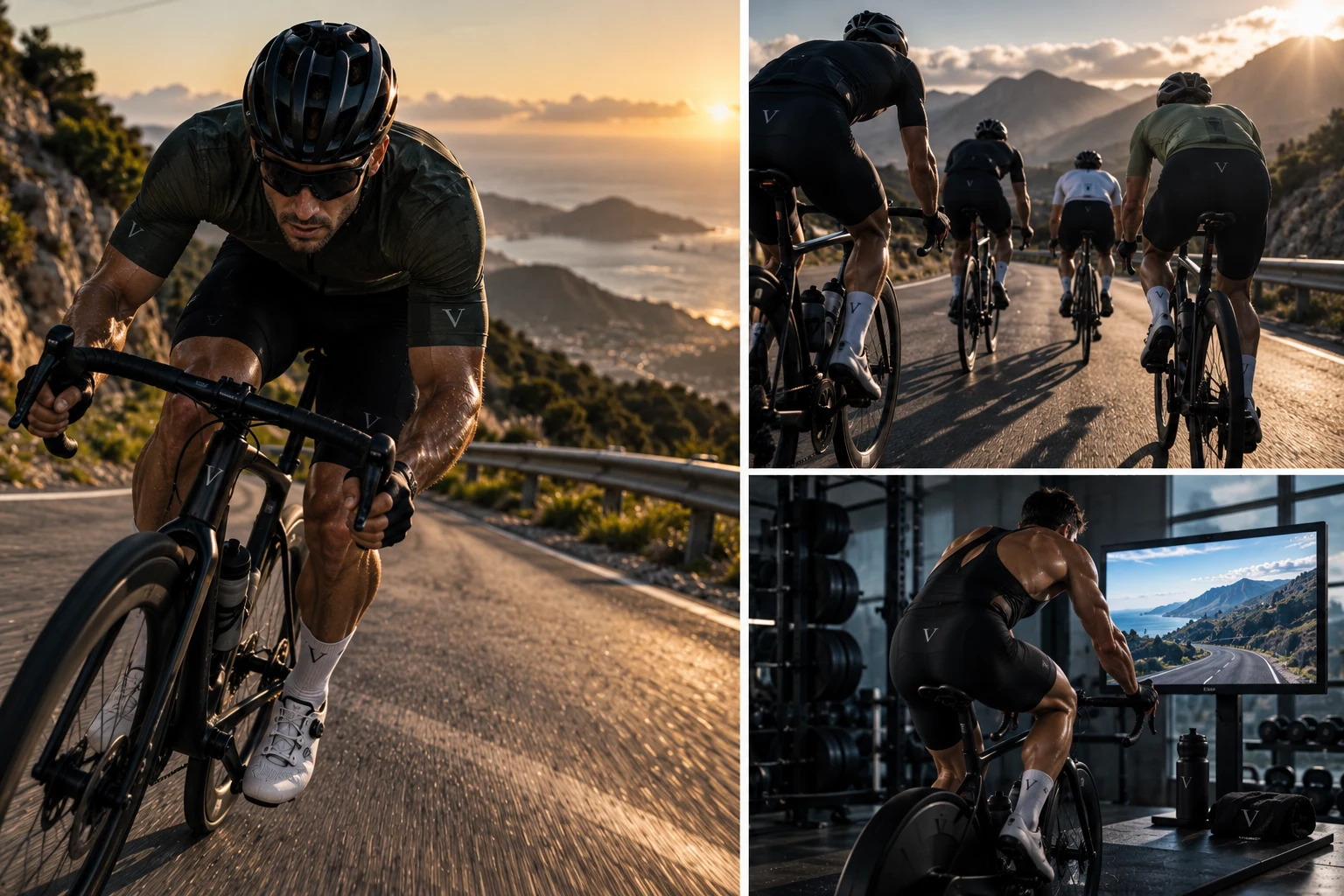
Traffic, storms, lightning, excessive heat, strong winds and poor visibility can justify an indoor session. Preserve its purpose and, when appropriate, duration and effort; do not automatically copy distance, because machines calculate kilometres differently. A 60-minute aerobic ride can become around 60 minutes indoors at a compatible intensity. Climbs and intervals require specific adjustments. Indoors, ventilation and heat management also matter.
12. Tracking progress without expensive equipment
Record duration, distance, weekly frequency and perceived effort. Power and heart rate add context when available. A 12-minute test on the same stationary bike, with standardized resistance and conditions, can help compare performance after several weeks. Do not directly compare different machines or treat that result alone as a precise VO₂max or FTP measurement. Times on standardized routes, interval consistency and weekly volume can also guide decisions.
13. How VETOR connects with preparation
Two users may want to complete 100 kilometres, while one already rides 70 and the other only 20 comfortably. The goal is similar; the starting point is not. VETOR aims to connect goals, sports, training history, prescription and tracking, considering experience and available time. Combining strength and cycling requires attention to total recovery. A 45-minute interval session does not automatically replace every adaptation from a long ride.
Technology must respect what has been implemented and validated. We do not claim that VETOR already calculates FTP automatically, interprets every power meter or predicts race results. Missing data must not be invented. The value lies in organizing useful information for decisions that take context into account.
14. Is there a best training model?
No distribution has demonstrated universal superiority. Polarized training combines substantial easy work with a smaller hard component; other models distribute effort differently. Cove and colleagues reinforce the importance of consistency, duration and organization. Choose according to level, competition demands, availability and individual response. Good training does not require a complicated programme; it requires each stimulus to have a purpose.[1]
VETOR — DON’T GUESS.
Discover the VETOR approach and follow a training experience connecting goals, sports and progression.
References
- Training distribution, duration and volume in cyclingCove et al. (2025) · Journal of Science and Medicine in Sport
- Adaptations to interval training in cyclistsNorte, Steele & Wright (2024) · International Journal of Strength and Conditioning
- Polarized training, VO₂max and economyNøst, Aune & van den Tillaar (2024) · Sports
- Heavy strength training for cyclistsLlanos-Lagos, Ramirez-Campillo & Sáez de Villarreal (2025 online; 2026) · European Journal of Applied Physiology
- Muscle damage and cycling performance metricsDevantier-Thomas et al. (2024) · Journal of Strength and Conditioning Research
- IOC consensus on relative energy deficiency in sportMountjoy et al. (2023) · British Journal of Sports Medicine
Educational content. Examples do not replace individual assessment or prescription. Illustrative images are not technique instructions.