
Cycling and Zone 2: why the same watts can cost more — and how to train endurance with precision
Power, heart rate and perceived exertion do not measure the same thing. Learn to combine them to build aerobic endurance, manage fatigue and improve performance without turning every ride into a race.

Same watts, different effort
Imagine two sessions by the same cyclist on the same bike at 180 watts. In the first, heart rate is 135 bpm, breathing is controlled and conversation is easy. In the second, it is 153 bpm, the legs feel heavy and maintaining power requires more concentration. The power meter reading has not changed, but the physiological cost has.
Power, heart rate, intensity zones, RPE, duration, weekly volume and FTP or threshold tests can all help. The problem is treating any one of them as an absolute truth. Are you chasing the number on the screen or the adaptation you want to develop? Training precisely means connecting the two.
Power measures the rate of work, not its entire cost
Watts represent mechanical work per unit of time. Sustaining 250 watts on a climb allows comparisons under similar conditions, but does not explain metabolic demand on its own. Temperature, accumulated fatigue, hydration, mechanical efficiency, duration and fitness affect the response. Two athletes at 200 watts can be at very different relative intensities: one has years of training and a high VO₂max; the other is just starting.
This is the distinction between external and internal load. External load describes the work performed, such as power and duration. Internal load describes the response: heart rate, ventilation, RPE and other physiological variables. A 60-minute session at 180 watts can have similar external load on two days but different internal responses. Interpreting their relationship helps explain how the athlete is responding.
Zone 2 is not a universal percentage of heart rate
In a five-zone model, Zone 2 usually describes a comfortable aerobic intensity for longer sessions. In the physiological three-zone model, the first zone is below the first threshold; the second lies between the first and second thresholds; the third is above the second. “Zone 2” therefore does not mean the same thing in every system.
In 2025, a panel of 14 scientists and coaches proposed locating Zone 2 immediately below the first lactate or ventilatory threshold. They also emphasized that the expected adaptations are not exclusive to that range: slightly higher or lower intensities can produce aerobic benefits. There is no magical heart rate that switches mitochondrial development on or off. Define the model and the goal before interpreting the zone.[1]
Same maximum heart rate, different zones
Two cyclists can have a maximum heart rate of 190 bpm yet reach their first threshold at quite different values. A formula based only on maximum heart rate does not guarantee the same physiological stimulus for both. In February 2025, a study assessed 50 cyclists — 30 men and 20 women — comparing ways to define Zone 2 using power, heart rate, lactate, ventilation and substrate oxidation.
The methods showed substantial variability, with coefficients of variation ranging from 6% to 29%. Individualized markers, particularly the first ventilatory threshold, provided more consistent references than some fixed percentages. Population formulas can be a starting point, but cannot replace individual assessment. This does not require everyone to visit a laboratory; it means acknowledging uncertainty in estimates.[2]
Finding an appropriate intensity without a laboratory
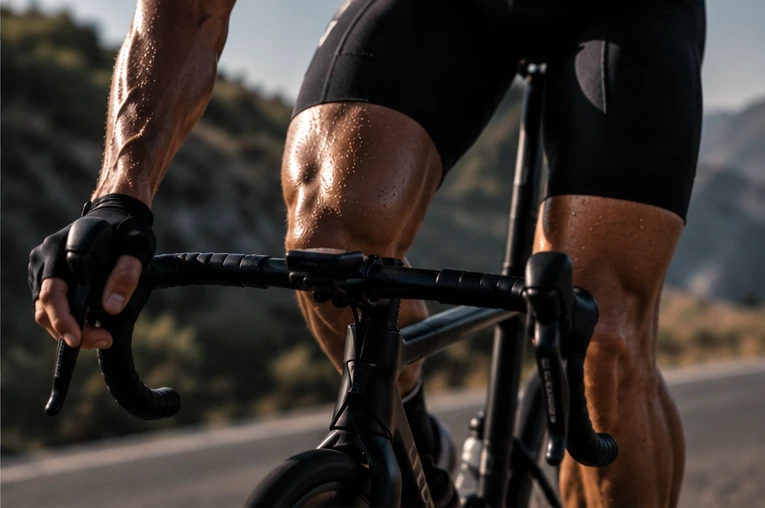
The talk test is an accessible approximation: during a comfortable aerobic session, you can usually speak in complete sentences while breathing faster than at rest but remaining in control. When conversation becomes difficult, intensity may have exceeded the session's goal. The test helps guide effort; it does not measure everyone's first threshold precisely.
On an RPE scale from 0 to 10, values around 2 to 4 can provide an initial reference for light to low-moderate effort. They are not a universal definition of Zone 2. Combine perception, breathing, duration and, if you have a reliable sensor, heart rate. Heart rate also varies with heat, hydration, stress and exercise duration. Better context makes the number more useful.
Cardiac drift: heart rate rises without more watts
During prolonged continuous exercise, heart rate can rise even at constant power. This cardiovascular drift often involves lower stroke volume and greater cardiovascular demand. Heat and dehydration can amplify it. The review by Périard and colleagues describes how heat stress and water loss alter thermoregulation and cardiovascular stability.
Imagine 90 minutes on the trainer: initially 180 watts, 135 bpm and RPE 3; after 70 minutes, still 180 watts but 150 bpm and RPE 5. The power meter is not necessarily wrong. Your body may be under greater stress. This does not prove poor fitness, dehydration or any specific cause. The numbers call for context, not an automatic diagnosis.[6]
Heat changes how training should be interpreted
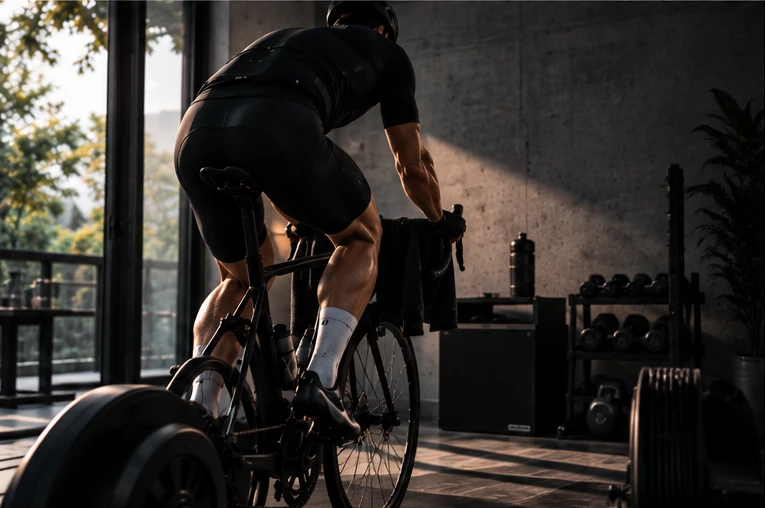
An indoor session in a cool, ventilated room does not have the same cost as one in a hot garage with little airflow, even at identical power. Insisting on the watts can make a controlled aerobic session much more demanding. Observe temperature, ventilation, hydration, heart rate, RPE and signs of heat intolerance.
When conditions are excessively hot, you may need to reduce intensity or duration and seek a better environment. Indoor training only helps if conditions are actually more suitable. A prescription must account for where it will be performed. Preparing ventilation and access to water is part of organizing the session, not an afterthought.[6]
FTP is useful, but does not describe all of your physiology
One popular protocol estimates FTP as 95% of average power during a maximal 20-minute effort. It is practical, but does not guarantee you can sustain that power for an hour. In 2025, a study of 22 trained cyclists found good test repeatability but substantial variation in time to exhaustion: approximately 42 ± 17 minutes. Only six participants were within ten minutes of the one-hour reference.
This does not make FTP useless. If an estimate of 250 watts is used to define all zones, it should be checked against the athlete's actual response. An inaccurate reference can make sessions harder, easier or less sustainable than intended. Testing provides a starting point; training helps check whether it still makes sense.[4]
Endurance also shows up when you are already tired
Two cyclists can reach 300 watts in a rested test and retain different amounts of that ability after two hours of riding. Physiological durability is resistance to the deterioration of endurance-related characteristics during exercise. Assessing an athlete only when rested leaves part of that story untold.
A 2025 study of 12 competitive cyclists compared tests before and after moderate or heavy exercise with equal total work. Peak ramp-test power and W′ — work capacity above critical power — decreased. Other variables did not change significantly, and there was no clear difference in deterioration between conditions. The study is small and establishes no universal rule, but highlights the importance of performance after accumulated work.[5]
Power at the start of a race is not the whole story
In a 120-kilometre race, you need to sustain power, manage climbs, respond to accelerations and still produce force at the finish. Your best rested five-minute effort does not necessarily show how you will repeat it after hours of activity. Duration, fatigue resistance and recovery between efforts complement maximum power, VO₂max and FTP.
Long, easy sessions provide exposure to prolonged exercise with generally less fatigue than intense efforts of equal duration. This helps sustain volume without turning every workout into a race. Duration must still match your experience and recovery capacity.
Easy training has a purpose too
“If I can talk, I am not really training.” That belief can lead cyclists to keep increasing power until an easy session becomes moderate or hard. Repeated throughout the week, easy days create extra fatigue and the athlete may reach demanding sessions without enough recovery.
The solution is not to ride slowly in every workout. It is to respect each session's role. An easy ride can be productive precisely because it accumulates work without unnecessarily compromising the next stimulus. Comfortable does not mean pointless; sometimes it means the session is doing its job.
80/20 is a tool, not a law
Polarized training places most work below the first threshold, a smaller share above the second and little time in between. In pyramidal training, low intensity dominates, followed by moderate and then high intensity. Other programs emphasize thresholds more. The familiar 80/20 ratio also changes meaning depending on whether you count minutes in zones or sessions.
A meta-analysis published in 2025 included 41 studies, 81 groups and 797 trained cyclists. VO₂max and time-trial performance improved, with no statistically significant differences between the authors' polarized and non-polarized categories. Longer interventions were associated with better VO₂max outcomes. No detected difference does not prove equivalence or identify an ideal ratio for everyone. Choose a sustainable distribution for the athlete's abilities and goals.[3]
Zone 2 cannot replace every intensity
Doing nothing but Zone 2 for months may leave gaps in preparation for hard climbs, attacks, sprints and time trials. Training near threshold and high-intensity intervals can develop specific aspects of performance that an exclusively easy routine does not fully address.
The dose depends on ability, history, available time, goals and recovery. Beginners can improve considerably with simple sessions; advanced cyclists may need more specific stimuli. Every workout need not be difficult, but training should prepare the intensities the sport actually requires.
A cycling week with direction
The example below is for a healthy recreational rider who is already accustomed to cycling three times a week and wants to improve endurance and tolerance of harder efforts. Space sessions to allow recovery. This is an illustrative structure, not an individual prescription.
| Session | Goal | Example to adapt |
|---|---|---|
| Ride A | Aerobic base | 45–60 comfortable minutes with controlled breathing |
| Ride B | Hard efforts | Warm-up; 4 × 3 hard minutes with 3 easy minutes between repetitions; cool-down |
| Ride C | Longer endurance | 60–90 minutes at a comfortable, sustainable intensity |
Keep breathing controlled and effort sustainable on easy rides. In intervals, avoid starting so hard that you cannot finish the repetitions. If you are not yet accustomed to vigorous effort, begin with continuous training and introduce intervals gradually. After several comfortable weeks, one possible progression is to extend the long ride from 60 to 70 minutes and observe your response. Excessive fatigue or persistently falling performance calls for review; increasing volume need not be automatic.
Three metrics, three questions
Power: how much mechanical work am I producing per unit of time? Heart rate: how is my cardiovascular system responding? RPE: how much effort does this task demand? These signals can agree or diverge, and disagreement can also be useful.
Constant power with rising heart rate can accompany prolonged effort and heat stress without automatically indicating lost fitness. Lower power with high RPE calls for a look at recovery and accumulated load. Higher power at similar effort, repeatedly under comparable conditions, can be a positive sign. One session cannot prove the cause; trends help interpretation.
Five mistakes that limit your riding
Treating Zone 2 as a universal heart rate; increasing watts whenever a workout feels comfortable; ignoring temperature and duration; treating FTP as a perfect measurement; believing only easy training develops endurance. All these mistakes remove numbers from their context.
Percentages are estimates, comfort may be the session's purpose, and equal watts do not guarantee equal responses. FTP should be checked against real experience. The mix of easy work, threshold and high intensity must respect the sport, training history and recovery, without automatically copying someone else's program.[2][4][6]
How to tell whether endurance is improving
Repeat a familiar session in similar conditions and observe weeks, not just one day. Does the same power feel more comfortable? Is heart rate similar or lower during a comparable part? Can you sustain effort longer? Is RPE lower? Does performance deteriorate less near the end? Are you recovering adequately between sessions?
No single signal proves a specific adaptation. Together, they reveal more than an occasional record. The aim is not to obtain better numbers in every workout, but to build a consistent, sustainable improvement trend.
How VETOR connects to this approach
Two users can complete the same endurance session yet respond differently: one finishes comfortably, the other reports excessive effort and difficulty recovering. Recording completion is useful, but interpreting goals, sport, history, prescription, frequency, progression, limitations and feedback adds context to the next decision. That is the VETOR proposition.
Was the planned workout easy or hard? Was it completed as expected? Does the next session have a different demand? Should the plan change? These questions do not mean VETOR already measures FTP, thresholds, power or cardiac drift automatically. Such metrics depend on sensors, integrations and specific features. The principle is to use data that is actually available, without assuming measurements that were never taken.
The best decision is not always to increase load
If a user marks an aerobic session “too easy,” increasing intensity is not the only possible response. Perhaps the goal was to accumulate volume with little fatigue; perhaps there were already two hard workouts that week. Making everything harder can interfere with the plan.
“Too hard” needs context as well: an inappropriate prescription, a hot environment or accumulated fatigue are possibilities, not automatic conclusions. One report does not require reducing all future workouts. Intelligent adaptation balances program stability with individual response and adjusts patterns when necessary.
What to notice on your next ride
Define your goal before setting out. For aerobic base work, choose a controlled intensity. Use power as a reference if measurement is reliable; observe heart rate when available and consider breathing and RPE. Notice how your response changes from start to finish. Indoors, address ventilation and temperature; outdoors, consider conditions and safety.
Record the experience afterward. You do not need to find the perfect number in one session. Build individual references and compare similar workouts in conditions that are as close as possible. Patterns over weeks tell you more than chasing a record on every ride.
Conclusion: train the goal, not just the watts
Power indicates the rate of mechanical work; heart rate shows part of the cardiovascular response; RPE adds individual experience; duration reveals how these relationships change. Research highlights variation between methods of defining Zone 2, the absence of adaptations exclusive to that range and the lack of universal superiority of one intensity distribution.
Better training means understanding why an intensity was chosen, performing the stimulus, observing the response and progressing with adaptation. Two cyclists can produce the same watts without the same relative effort. The goal is to develop the ability to sustain power when it matters, including after accumulated work.[1][2][3][5]
VETOR — DON’T GUESS.
Performance is built through repeated decisions: when to increase, maintain, recover, build endurance or seek intensity. VETOR was conceived to connect prescription, progression, history, goals and feedback in a process of individualized development. A completed session is only part of the story.
Do not turn every ride into a race. Do not confuse intensity with quality. Train with purpose, develop endurance, build power and track your progress.
Build on what you have learned.
Discover VETOR: weekly planning, structured sessions and training history. Join the waitlist for updates on app availability.
References
- Zone 2: definition, methods and expected adaptationsSitko S et al. International Journal of Sports Physiology and Performance · 2025
- Individual variation between methods of defining Zone 2Meixner B, Filipas L, Holmberg HC, Sperlich B. Translational Sports Medicine · 2025
- Training distribution, duration and volume in cyclistsCove B et al. Journal of Science and Medicine in Sport · 2025
- Repeatability and validity of the FTP testGough LA et al. Journal of Science and Cycling · 2025
- Durability after moderate or heavy exerciseEvans G, Chorley A, Highton J. European Journal of Sport Science · 2025
- Exercise in the heat: thermoregulation, hydration and performancePériard JD, Eijsvogels TMH, Daanen HAM. Physiological Reviews · 2021
Educational content. The sample week is illustrative and should be adapted to experience, health and recovery. Stop exercising if unusual symptoms or signs of heat intolerance occur. Images are illustrative. VETOR is not presented here as an automatic measurement tool for FTP, thresholds or cardiac drift.