
Swim training for speed and endurance: how to improve from 50 to 1,500 metres
Swimming more kilometres does not mean swimming faster. Learn to organise sets, recovery intervals, strength work and progression around your distance, ability and goal.
Why swimming more does not always mean swimming faster
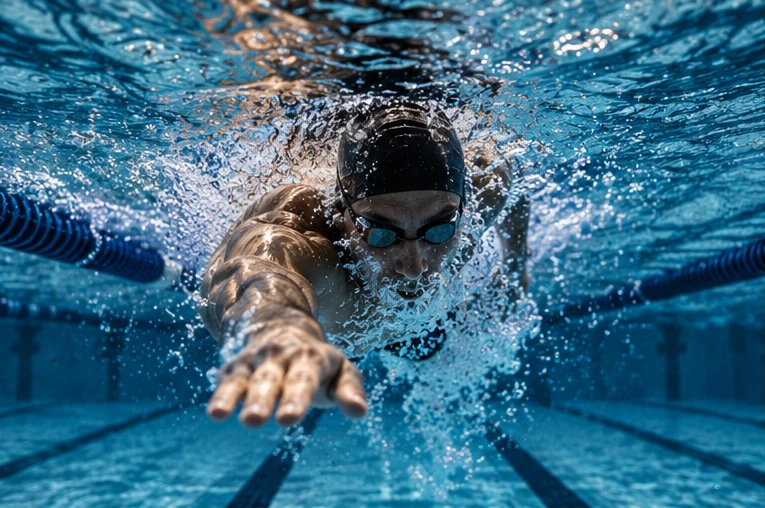
Imagine two swimmers who can complete 1,500 metres without stopping, both training four times a week. The first always repeats a distance at a comfortable speed. The second balances aerobic endurance, intense efforts, recovery and strength work outside the pool. We cannot predict who will win a 400-metre test, but the second plan trains different capacities with clear purposes.
A 2026 meta-analysis pooled 11 studies and 237 competitive swimmers and found average improvements in aerobic capacity and performance with high-intensity interval training. The average age was approximately 15: findings from competitive athletes, many of them adolescents, should not be automatically applied to recreational adults or beginners.[1]
Benefits varied by protocol and population. The useful message is to organise training around the goal, without turning one workout into a universal formula.
1. What determines speed in the water?
Propulsion, hydrodynamic drag, coordination and energy availability work together. The aerobic system supports sustained efforts and recovery between intense repetitions. Anaerobic processes contribute especially to acceleration and short events, but no distance relies exclusively on a single system.
Muscular strength matters, but getting stronger in the gym does not guarantee a proportional improvement in the water. Transfer depends on coordination and sport-specific training. Technical efficiency requires learning: physical preparation complements the work of a swimming instructor rather than replacing it.
2. Different distances, different priorities
A 50-metre programme should not simply be a smaller version of a 1,500-metre programme. The table outlines general priorities, not rigid physiological boundaries.
| Distance | Priority | Example stimuli |
|---|---|---|
| 50 m | Speed and power | Short sprints, generous recovery |
| 100 m | Sustain high intensity | Fast repetitions and specific sets |
| 200 m | Speed, endurance and pacing | 50–200 m intervals |
| 400 m | Aerobic capacity and sustainable pace | 100–400 m sets |
| 800 m | Endurance and maintaining speed | Medium and long intervals |
| 1500 m | Endurance and pacing | Long sets and event-specific pace |
| Open water | Endurance in variable conditions | Supervised specific preparation |
Sprinters also need aerobic capacity, and distance swimmers can benefit from speed work. A 2021 review of elite swimmers found differences in training organisation by event, but did not identify a universally superior periodisation model. The balance and distribution of training stimuli change.[5]
3. Why split the distance into intervals?
Instead of attempting a 400-metre personal best every session, splitting the effort into 4 × 100 metres allows you to control pace, recovery and repeatability. Intervals alone do not make a workout effective: distance, speed, rest and volume must work together.
In the 2026 review, interventions lasting at least eight weeks had larger average effects than shorter interventions. This comparison between studies does not establish a mandatory minimum time to improve, or prove that duration alone caused the difference.[1]
For example, a comfortable 4 × 200 metres can prioritise aerobic endurance; a demanding but sustainable 8 × 100 metres, specific endurance; and a fast 8 × 25 metres with plenty of recovery, speed. The same distance with different effort or rest can create a different stimulus.
4. CSS: an individual pace reference
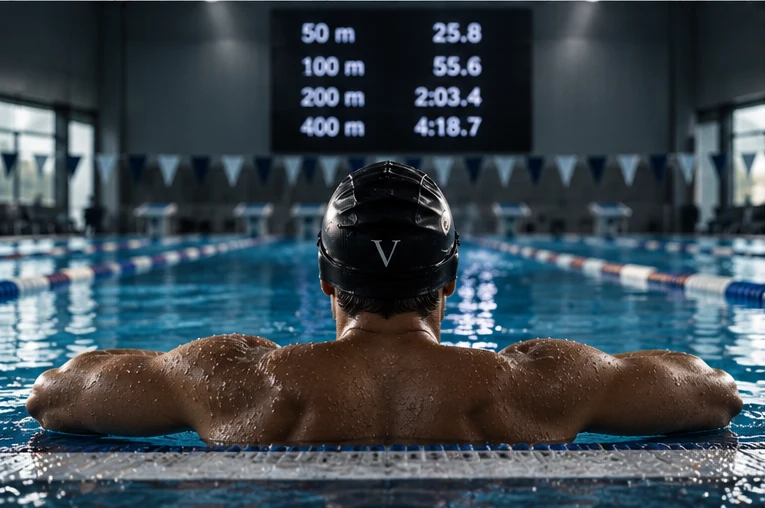
Expecting the same 100-metre time from someone who swims 400 metres in six minutes and someone who needs nine ignores their different capacities. Standardised tests help establish individual references.
Critical Swim Speed (CSS) can be estimated using maximal 200- and 400-metre tests. Scott and colleagues assessed 32 national-level swimmers and found good reliability for critical speed, but lower reliability for other model variables. The study appeared online in 2023 and is part of the 2024 volume.[4]
| Test | Time | In seconds |
|---|---|---|
| 200 m | 3:20 | 200 s |
| 400 m | 7:00 | 420 s |
In this example, CSS = (400 − 200) ÷ (420 − 200) = 200 ÷ 220 ≈ 0.91 m/s. The corresponding pace is 110 seconds per 100 metres, or 1:50/100 m. Use times in seconds in the calculation.
CSS is not a speed that can be sustained indefinitely and does not necessarily equal a measured lactate threshold. It does not automatically assess technique, strength, maximal oxygen uptake or a future result. Maximal tests are only appropriate for competent, sufficiently fit swimmers, in a suitable setting with recovery between tests.
5. Three sample sessions with clear objectives
These examples are for healthy adults who already swim safely and can complete the distances. They illustrate training organisation, rather than individual prescriptions or protocols validated in these exact configurations. Adjust rest and volume to current ability; beginners do not need to start with these sessions.
Session A — Aerobic endurance
Goal: sustain prolonged efforts. Intermediate level. An effort rating of 5–6/10 during the main set can provide an initial reference, without representing a measured physiological zone.
| Step | Prescription | Effort and rest |
|---|---|---|
| Warm-up | 300 m | Easy |
| Preparation | 6 × 50 m | Easy; 15–25 s |
| Main set | 4 × 200 m | Moderate; 20–30 s |
| Continuation | 4 × 50 m | Comfortable |
| Finish | 100 m | Very easy |
Total: 1,700 metres. Keep effort relatively steady; the final 200 metres do not need to become a maximal test. The stated rest intervals are between repetitions.
Session B — High-intensity endurance
Goal: repeat demanding efforts. Intermediate to advanced level. An effort rating of 7–8/10 during the main set can help calibrate the session while keeping times consistent.
| Step | Prescription | Effort and rest |
|---|---|---|
| Warm-up | 300 m | Easy |
| Preparation | 4 × 50 m progressive | Moderate |
| Main set | 8 × 100 m | Demanding; 25–45 s |
| Active recovery | 4 × 50 m | Easy |
| Finish | 100 m | Very easy |
Total: 1,600 metres. Each repetition should not be an all-out effort. If pace falls substantially or execution becomes unsafe, increase recovery, reduce repetitions or end the set.
Session C — Speed and power
Goal: swim fast over short distances. For intermediate or advanced swimmers with sprint experience.
| Step | Prescription | Effort and rest |
|---|---|---|
| Warm-up | 300 m | Easy |
| Preparation | 4 × 50 m progressive | Moderate |
| Speed | 8 × 25 m | Very fast; 60–90 s |
| Complementary set | 4 × 100 m | Moderate |
| Finish | 200 m | Easy |
Total: 1,300 metres. The 60–90 seconds of recovery help preserve speed. Resting for only five seconds would change the stimulus through accumulated fatigue; it is not necessarily useless, but it does not offer the same opportunity to repeat high-quality fast efforts.
6. Turning a 500-metre goal into a plan
Moving from 500 metres in 10 minutes to 9 minutes requires changing average pace from 2:00 to 1:48/100 m: a difference of 12 seconds per 100 metres. That does not mean swimming every session at target pace.
Combine an aerobic base, progressively demanding intervals, brief exposures to higher speeds, complementary strength work and periodic assessments. A beginner may first need to complete 500 metres consistently; an experienced swimmer may work on a specific limitation. The goal should remain compatible with the response to training.
7. Can strength training help you swim faster?
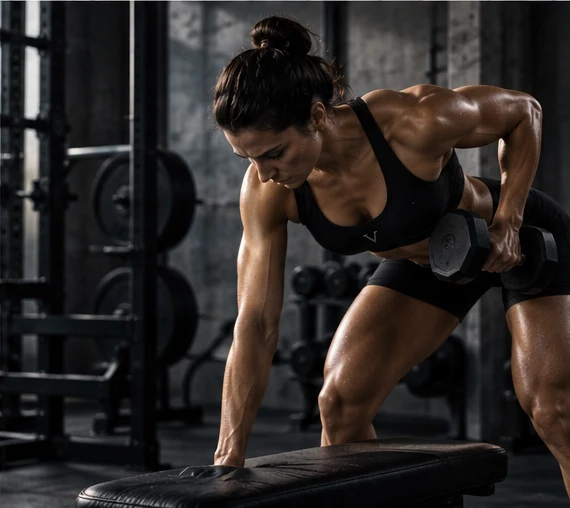
A 2025 network meta-analysis pooled 36 randomised studies and 844 competitive swimmers. Combining in-water work with resistance training outside the pool produced favourable results across several measures, especially in some short events. The diversity of protocols prevents identifying one ideal strategy.[2]
The gym develops general capacities; the pool provides the specific context. You do not need to mimic the stroke in every exercise or perform every movement below.
| Exercise | Capacity trained |
|---|---|
| Lat pulldown | Upper-body strength |
| Row | Pulling strength and trunk control |
| Squat | Lower-body strength |
| Split squat | Unilateral strength |
| Appropriate deadlift variation | Hips and posterior chain |
| Trunk stability | Control and muscular endurance |
| Low- or moderate-complexity jumps | Lower-body power |
A 2024 review of 13 studies and 267 swimmers also found benefits for upper-body strength and performance over 25 to 200 metres. If gym work consistently compromises pool quality, adjust its dose. Choose exercises according to experience, limitations and tolerance.[3]
8. A possible week: three swims and two strength sessions
This example may suit an intermediate recreational swimmer with enough time and recovery for five sessions. It is not a requirement for improvement.
| Day | Training | Goal |
|---|---|---|
| Monday | Aerobic swim | Resistance |
| Tuesday | Resistance training | General strength |
| Wednesday | Interval swim | High-intensity endurance |
| Thursday | Recovery | Manage fatigue |
| Friday | Speed swim | Speed and power |
| Saturday | Resistance training | Complementary strength |
| Sunday | Rest | Recovery |
Beginners may need fewer sessions; advanced athletes may need a different distribution. Those who also run or cycle must consider total load. Different sports still draw on some of the same recovery resources.
9. Progress without endlessly adding kilometres
You can progress through volume, pace, repetition consistency or specificity. Rest intervals can also change according to the goal, but shortening them is not automatically an improvement. Avoid making every variable more demanding at once.
If you already complete 6 × 100 metres at a given pace, first make the times consistent. With good tolerance, move to 7 × 100. At another stage, try a slightly faster pace. Keeping the programme unchanged for a week can also be the right decision; progress does not require daily records.
10. How to assess improvement
A 400-metre test improving from 7:00 to 6:50 after six weeks may indicate progress. Before drawing conclusions, compare pool length, stroke, start type, rest and testing conditions.
| Metric | What it indicates |
|---|---|
| 50 m time | Short-distance performance |
| 100 m time | Speed in a specific effort |
| 200 m time | Middle-distance performance |
| 400 m time | Performance and CSS reference |
| Pace per 100 m | Swimming speed |
| Repetition consistency | Ability to sustain performance |
| Perceived effort | Subjective demand |
| Weekly volume | Amount of training |
Heart rate can add context when measured appropriately, but running zones should not be automatically transferred to water. Look at trends and consistent comparisons rather than one isolated session.
11. Five mistakes that limit results
Always swimming at the same speed can maintain fitness without addressing the capacity limiting performance. At the other extreme, making every session intense accumulates fatigue and reduces the quality of subsequent training.
Insufficient rest in a speed session can prevent truly fast repetitions. Copying an Olympian's mileage ignores years of preparation and a different recovery routine. And strength training, although useful, does not replace specific practice in the pool.
12. Safety is part of the session
Do not use hyperventilation or prolonged underwater breath-holding to try to improve endurance: these practices can cause loss of consciousness and drowning. The CDC recommends swimming with a buddy and choosing lifeguarded locations when possible.[6]
For beginners, basic water safety skills come first. Stop exercising if you experience significant dizziness, chest pain, unusual shortness of breath or loss of coordination, and seek assistance. Physical fitness does not eliminate water-related risks.
13. Where does VETOR fit into the plan?
Someone aiming to swim 1,500 metres comfortably and someone aiming to improve their 100-metre time need different priorities. VETOR's purpose is to connect goals, ability, history and sports to organise physical preparation and track progress using the information available.
That includes considering interactions between the pool, gym, running and cycling. It does not mean replacing a swimming instructor or promising automatic stroke correction or biomechanical measurement without specifically implemented and validated capabilities. Distance, time and effort logs provide references; predictions require sufficient history and clear limitations.
14. Where to start
Define whether you want to complete a distance, improve a time or prepare for an event. Then identify your starting point: beginners prioritise safety and consistency; intermediate swimmers can distribute sessions with different purposes; advanced swimmers typically need greater specificity.
Endurance, speed, strength, recovery and specific practice complement one another. Use observable results to adjust the plan. There is no need to keep adding kilometres or turn every pool visit into a test.
VETOR — DON’T GUESS.
Swim with purpose. Develop the capacities your goal requires and track your response to each stimulus. VETOR was conceived to connect goals, sports and history in an individualised training experience. Every session should have a purpose; every progression should make sense.
Build on what you have learned.
Discover VETOR: weekly planning, structured sessions and training history. Join the waitlist for updates on app availability.
References
- HIIT in competitive swimmersJin R et al. · Journal of Science and Medicine in Sport · 2026
- Combining swimming and strength trainingWang Z et al. · Frontiers in Physiology · 2025
- Resistance training and short-to-middle-distance performanceFrontiers in Physiology · 2024
- Reliability of critical speed testsScott BE, Burden R, Dekerle J · Journal of Human Kinetics · 2024
- Intensity, volume and periodisation in elite swimmersGonzález-Ravé JM et al. · International Journal of Sports Physiology and Performance · 2021
- Drowning prevention and water safetyCenters for Disease Control and Prevention · 2025
Educational content. Examples are for healthy adults who already swim safely; they do not replace individual assessment or technical instruction. Adjust training to your ability and seek qualified guidance when needed.