
Rucking and loaded hiking: how to carry more without simply adding weight
A backpack changes the demands of a walk. Consider distance, pace, terrain, duration, carried weight and recovery together. Progress means preparing for the actual task, not simply adding more weight to your back.
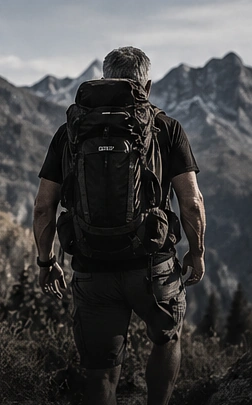
Hiking is a family activity. Putting on a backpack and repeating the route may seem like a simple way to make your workout more difficult. But the result is not just the same walk with greater energy expenditure.
The load carried changes the demands of the task. The equipment needs to be sustained for a long time; ascents and descents modify the effort; heat, footwear and terrain influence the experience. The sum can be very different from a comfortable unladen walk.
Rucking usually designates walking with a loaded backpack as training. Hiking is a trail activity that can involve varying loads, from a small backpack to multi-day equipment. Language boundaries vary, but programming must describe the concrete task.
The backpack is just one of the variables
Compare a short walk on flat ground with a long, uneven and hot crossing. Even with the same mass in the backpack, the demands are different.
A useful description includes the weight carried, time, distance, gradient, surface type, pace and environmental conditions. It also matters if the person is used to the activity and what they trained in the previous days.
The literature on load carrying in the military treats preparation as a multifactorial problem, which combines conditioning, strength, specific exposure and recovery. A 2025 international outlook on rehabilitation for these tasks reinforces the need to rebuild capacity according to real requirements.[1]
Application to recreational practitioners requires caution. Military contexts involve selection, training, equipment and objectives. The fact that a group carries heavy loads does not make this value an initial recommendation for everyone.
Cardiovascular fatigue does not describe all the difficulty
A person can breathe relatively comfortably and still experience fatigue in the feet, legs or structures that support the backpack. Another may have enough strength to lift the load, but not be prepared to carry it for hours.
This shows why a good squat or a fast run alone do not describe the ability to perform a march. There is specificity in duration, equipment and task.
A 2026 study of experienced military personnel evaluated prolonged weight-bearing walking and observed changes in gait variables and neuromuscular performance following exposure. The sample and protocol do not define the behavior of every practitioner, but they show that the effect is not limited to the cardiorespiratory system.[2]
Planning should ask what tends to limit the task: conditioning, strength, local tolerance, equipment, nutrition or initial pace. Adding more load without this reading may just magnify the wrong problem.
There is no universal starting percentage
It is common to find rules that define the backpack as a fixed percentage of body weight. A ratio can help describe the exposure, but it does not guarantee that it is appropriate.
Two people with the same body mass can have very different experience, symptom history, and conditioning. Distance and terrain also change the meaning of that weight.
For those just starting out, it makes sense to first build the ability to walk for the desired time and environment. Then, adding a small, stable load can be a step, when compatible with the person's condition.
“Small” should not be turned into a mandatory number. The starting point can even be just the essential equipment. Returning after injury or preparing for professional demands deserves specific guidance, not a rule taken from a video.
Progressing a variable helps you understand the answer
Imagine that the person simultaneously increases weight, distance, pace and gradient. If the session is no longer tolerated, it is difficult to identify which change had the greatest influence.
A practical proposal is to choose the priority of the period. Maintain the weight and extend the time a little, or preserve the duration and try terrain more similar to the objective. The size of the change depends on history; There is no universally safe weekly increment.
This reasoning does not prove that modifying just one variable prevents injury. It improves schedule traceability. It's easier to compare sessions when conditions don't change all at once.
Progression can also be completing the same task with less effort or recovering better for the next session. More weight is not the only way to evolve.
General strength and specific exposure play different roles
Strength exercises can develop useful abilities to support and move the body. Knee and hip patterns, calf work and carrying tasks can be part of a preparation, depending on the goal and tolerance.
However, lifting a load for a few repetitions does not replace prolonged exposure to the backpack. Likewise, loaded walking does not necessarily offer the best dose for developing maximum strength.
The preparation described in the load transport literature considers the combination, not the competition between methods. The amount of each component should depend on what the practitioner lacks.[1]
A strength session doesn't have to mimic every step on the trail. Can develop general qualities with load and range of motion control. Specific hiking offers the opportunity to integrate these capabilities with equipment, duration, and terrain.
Ascent and descent are not equivalent
The same route can contain very different tasks. On the way up, the pace and incline change the demand. When descending, it is necessary to control the displacement and deal with the terrain, often when some of the fatigue has already accumulated.
Therefore, planning only the outward distance may be insufficient. Feedback is part of the session. The person needs to reserve the capacity to walk carefully, and not just reach a point on the map.
A practical application is to first test routes with simple return options. Increasing the complexity of navigation and terrain while greatly increasing the load reduces the adaptation margin.
Clock unevenness may also contain an error. An implausible elevation gain should not automatically be accepted as an accurate measure of work done.
Equipment participates in the experience
An ill-fitting backpack, a shifting load or points of friction can alter how the session is tolerated. Adjustment and familiarization should happen before a major activity, not for the first time during a long crossing.
Footwear, socks and protection from environmental conditions need to be compatible with the task. There is no single ideal product for everyone; The objective here is not to recommend a purchase, but to remember that preparation includes testing the set that will be used.
Initial comfort also does not guarantee comfort after hours. A short route can act as a practical assessment before increasing the duration. Relevant changes to equipment should be recorded as changes in exposure.
Pain or loss of sensation caused by compression should not be treated as a mandatory part of training. Interrupting, readjusting and evaluating can be more responsible than insisting.
Heat, nutrition and hydration are not details
A session in hot conditions may require different organization of schedule, pace, breaks and access to water. Carrying extra weight to make training more difficult should not compromise essential safety items.
In prolonged activities, food and fluid availability need to be planned according to duration, environment and individual needs. The general guideline to adapt intake to sporting demand appears in nutrition and performance consensus statements.[3]
There is no benefit in turning dehydration or lack of food into a test of discipline. It is also not appropriate to drink excessive amounts of water as a fixed rule. Planning must be individualized, especially in demanding environments.
Dizziness, confusion, unusual weakness or other concerning signs require stopping the activity and seeking help depending on the situation. The goal is training, not surviving a poorly planned session.
Example of organization, not mandatory load
The table below is an illustrative proposal for someone who is healthy and used to walking. It is not a military selection or return from injury protocol.
| Component | Function of the week |
|---|---|
| Comfortable walking | Build or maintain movement time without major additional fatigue |
| Strength | Develop relevant general capabilities, with a compatible dose |
| Specific session with backpack | Familiarize yourself with equipment and demand, starting with tolerated exposure |
| Recovery | Allow previous sessions to not continually compromise subsequent ones |
A week may contain only one specific exposure, or another frequency, depending on the context. The number of sessions should not be copied without considering running, sports and weight training already present.
The first goal of a new dose may be to repeat it well, not to surpass it immediately. Demonstrating tolerance on more than one occasion provides better information than a single session completed with great difficulty.
Rucking does not exist outside of the week's load
An athlete runs, trains legs and plays football. Add a march on the weekend because “it’s just a walk”. On the calendar, it looks like a light activity. In the body, it may represent more relevant exposure to structures already required.
The solution is not to ban the combination. It’s about correctly naming the demand and distributing it. A long march can change what makes sense in your next leg workout. A heavy strength session can also influence the quality of your walk.
Look at the set. If the priority is an important track, perhaps other capabilities will temporarily go into maintenance. If the priority is running, the backpack may take up less space.
The study of prolonged walking in military personnel reinforces that acute effects on performance deserve consideration, without providing a universal window of recovery for every person.[2]
What's worth following
Record total mass carried, duration, distance, terrain and perceived effort. Add notes about relevant equipment, conditions, and symptoms. Without the weight of your backpack, comparing two sessions can be misleading.
Calories estimated by the clock are not a direct measure of the demand on muscles and joints. The algorithm does not always know the weight transported. An estimate that seems low is not reason enough to add load.
Compare similar tasks. The same route and the same equipment, in similar conditions, allow us to observe whether pace, effort and recovery have changed. A slower session on much more technical terrain may not make things worse.
Common mistakes
Using a military load as a recreational starting point, increasing all variables simultaneously, ignoring the descent, debuting equipment in a long activity and adding the backpack to an already very demanding week are planning errors.
It is also inappropriate to turn growing pain into a goal. Exertional discomfort and signs of a possible problem should not be treated as synonymous. Persistent pain, altered gait, loss of function or neurological symptoms require evaluation.
A session completed at any cost does not demonstrate that progression was appropriate. The impact on the following days is also part of the answer.
Where VETOR comes in
VETOR's proposal is to interpret the session within a history. Time and distance are useful, but freight transport requires recording other information so that the context makes sense.
The application must distinguish what was reported by the user, what came from a sensor and what is just estimated. Prescribing a certain backpack does not prove that that weight was used.
Integrating rucking, running and strength also avoids treating each discipline as an independent load. Concrete features depend on the available version; The principle is that today's training needs to communicate with yesterday's and tomorrow's.
Conclusion
Carrying more requires more than adding weight. Preparation must combine general capacity, specific exposure, equipment and progression of demands. Military literature offers important information, but should not be converted into an automatic prescription for every practitioner.[1][2]
A good session prepares you for the task and allows you to continue training. The objective is not to always end up more destroyed, but to make a relevant demand more manageable.
VETOR — DON’T GUESS.
The backpack changes the job. Planning needs to change along with it. VETOR seeks to relate modality, history and response so that progression is a decision, not just weight gain.
Don't train just to carry more. Train to get there, return and recover better.
Your goal deserves a plan.
Discover VETOR's proposal to organize training according to your routine and monitor progress.
References
- Orr R, Knapik JJ, Rodgers R, et al. Rehabilitating Soldiers for Load Carriage Tasks: An International Perspective. International Journal of Environmental Research and Public Health. 2025;22(8):1286DOI: 10.3390/ijerph22081286
- Muniz AM de S, Mainenti MRM, Diel AAC, et al. Effects of prolonged load carriage on gait, physiological and neuromuscular performance in experienced military personnel. Sport Sciences for Health. 2026DOI: 10.1007/s11332-026-01919-y
- Thomas DT, Erdman KA, Burke LM. Nutrition and Athletic Performance. Medicine & Science in Sports & Exercise. 2016;48(3):543–568DOI: 10.1249/MSS.0000000000000852
Educational content. Examples do not replace individual assessment and guidance from training and healthcare professionals.