Mobility and flexibility in training: build range of motion without losing strength, speed or power
More stretching does not always mean better movement. Learn how to combine range of motion, strength and body control and tailor your warm-up to the activity.

Do you need more flexibility or more control?
Imagine two people squatting. One achieves a large range in passive tests but loses balance during the exercise. The other has less passive range but controls the required movement. Better mobility depends on the task: having range available does not mean you can use it with strength and coordination.
A 2025 meta-analysis of 189 studies and 6,654 adults confirmed that static stretching improves flexibility and found limited returns from increasing its volume indefinitely. The useful question is: what range do you need to develop, and why?[1]
1. Mobility and flexibility are not the same
Flexibility describes available range. In a passive leg raise, for example, the result depends on muscular, tendon, joint and neural characteristics and stretch tolerance. The test does not necessarily demonstrate strength or voluntary control in that position.
In training, mobility usually describes the ability to access and control relevant ranges. A squat requires coordination of the hips, knees, ankles and trunk. Raising your leg passively to 100 degrees but reaching less range actively may involve strength and motor control; it does not diagnose an injury. Develop the capacity the task requires, rather than the greatest possible flexibility.
2. What happens when you stretch?
A 2025 review of 65 studies and 1,542 adults found small reductions in the stiffness of the tissues assessed and greater stretch tolerance after repeated interventions. The overall analysis found no significant change in muscle fascicle length.[2]
Gaining flexibility therefore does not necessarily mean making the muscle structurally much longer. Tolerance and mechanical properties can both contribute. Improving a range-of-motion test does not guarantee equivalent gains in strength, coordination or sporting performance.
3. Does static stretching before training hurt performance?
This is not a reason to ban all stretching. Duration, intensity, its place in the warm-up and the following task matter. A 2023 network meta-analysis of 35 studies favoured dynamic movements for certain jump and speed measures. Static stretching alone was unfavourable for sprinting; static and dynamic combinations had positive results for some jump measures.[5]
Before sprints, use progressive movements and gradual accelerations. Before resistance training, prepare the exercises with dynamic movements and progressively heavier warm-up sets; a specific restriction may justify targeted stretching. In combat sports, include footwork, rotations and technical actions. Prepare for the task you will actually perform.
4. Dynamic movements before explosive activities

Controlled leg raises, hip rotations and ankle movements explore progressively larger ranges. Controlled dynamic movements are not the same as high-speed ballistic actions. A warm-up should prepare force production and coordination as well as range.
The 2023 review found favourable results in protocols lasting approximately seven to ten minutes, with variation between studies. That is not a mandatory duration. A comfortable 30-minute run can begin with brisk walking and a gradual increase in pace; intense sprints may require more elaborate preparation.[5]
5. Resistance training can also improve flexibility
A 2023 review of 55 studies found range-of-motion gains with resistance training, without statistically significant differences from stretching in the comparisons analysed. In 2025, another meta-analysis of 36 studies and 1,469 participants found improved flexibility but highlighted heterogeneity and risk of bias.[3][4]
Strength can develop alongside the range you use. Technique, resistance, experience and individual characteristics influence the result. This does not mean every exercise works equally well or that deep movements with heavy loads are always necessary.
6. Full or partial range of motion?

Full range means the range defined for the exercise or protocol, not every joint's anatomical limit. Two people may squat to different depths because of anatomy, body proportions and movement capacity without either necessarily being wrong.
Partials can serve specific strength goals or change mechanical demands. Using only reduced ranges, however, limits exposure to other positions. Choose a comfortable range that fits the goal and allows progression.
7. How much stretching do you need?
Ingram and colleagues' meta-regression estimated an average plateau near four accumulated minutes per session for immediate effects and ten minutes per week for chronic adaptations. These are study estimates, not universal limits or requirements for each muscle or before every workout.[1]
A conservative suggestion is to begin with two 30-second sets for a specific region, three or four times a week. This is not a proven optimal dose or a guarantee. Observe your progress and adjust when needed: consistency and specificity matter more than accumulating minutes.
8. Ankles: connect range to the task
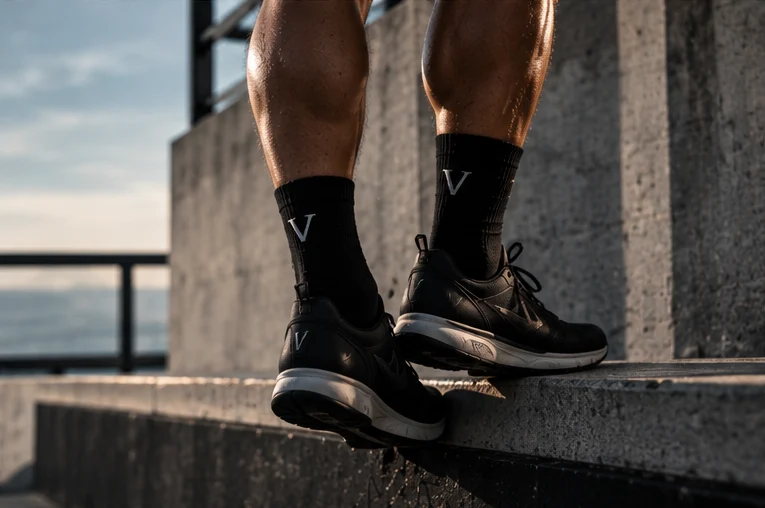
Dorsiflexion brings the foot towards the front of the lower leg. In a squat, the requirement depends on foot position, depth, body proportions and technique. Running and footwork require other combinations of force absorption and production; less dorsiflexion does not imply difficulty in every sport.
To explore the movement, slowly move the knee forwards with the foot supported and heel on the floor, within a comfortable range. Do not force a painful position. Then integrate that capacity into strength exercises such as squats or lunges. The photo illustrates the ankle region, rather than instructions for performing this drill.
9. Hips: more range does not always mean a better squat
Hip anatomy varies. If a foot position causes pinching at the front of the hip, that does not automatically mean you need more stretching. Adjusting technique or range may make the movement more comfortable.
Flexion, extension and rotation can be trained with controlled movements, seated transitions and squat variations, depending on the task. Pain, structural restriction and motor control are different issues. Avoid treating every difficulty as a lack of mobility.
10. Thoracic spine and shoulders
An overhead movement involves the scapula, humerus and other structures. Compensating for a restriction by excessively increasing movement elsewhere changes the execution. Thoracic rotations, controlled arm raises and strength work in appropriate ranges can be part of preparation.
A lifter, a combat athlete and a swimmer have different demands. Exercise selection should follow the goal, without turning a generic shoulder routine into a universal solution.
11. Does mobility reduce injury risk?
Increasing flexibility does not prove that injury risk falls. History, sporting exposure, intensity, fatigue, preparation and recovery also matter. Less range does not always mean more risk, and a large range does not guarantee protection.
Stretching can increase range; resistance training can develop strength and flexibility; dynamic movements can prepare you for activities. These are useful adaptations, but none should be presented as guaranteed prevention. Mobility is a physical capacity; injuries involve multiple factors.
12. A practical pre-training routine
For a healthy person, approximately eight to ten minutes of preparation can be a starting point. The example below is illustrative and may take longer depending on transitions and pace. It has not been validated as a universal protocol and need not be completed in full before every activity.
| Exercise | Illustrative volume | Goal |
|---|---|---|
| Brisk walking or light movement | 2 minutes | Gradually increase demand |
| Ankle mobilisation | 8–10 repetitions per side | Explore dorsiflexion |
| Controlled hip rotation | 6–8 repetitions per side | Prepare hip movements |
| Squat through a comfortable range | 8 repetitions | Integrate hips, knees and ankles |
| Controlled thoracic rotation | 6 repetitions per side | Explore trunk rotation |
| Sport-specific movement | 2–3 minutes | Prepare the main task |
For running, prioritise the lower body and a gradual increase in pace. For resistance training, prepare the planned movements and perform warm-up sets. For combat sports, include footwork, rotations and progressive technical practice. In cycling, the bike itself allows a gradual increase in demand. A warm-up prepares the session; it need not compete with it in duration or intensity.
13. Four weeks to organise your practice
This example assumes a healthy person and a region that genuinely needs more range. Use short blocks, preserve strength training and do not increase range, duration and intensity all at once.
| Week | Strategy | Goal |
|---|---|---|
| 1 | Short mobility sessions, 3 times | Familiarisation and control |
| 2 | Maintain frequency and improve execution | Consolidate technique |
| 3 | Gradually adjust range or volume if needed | Develop capacity |
| 4 | Reassess the same task and maintain or modify the stimulus | Check progress |
Reassess the same task under comparable conditions: similar foot position, load and execution. Going deeper because you changed the entire technique does not necessarily represent the adaptation you wanted. Four weeks do not guarantee measurable change; some adaptations take longer.
14. Five common mistakes
Mistaking all discomfort for poor flexibility; stretching intensely before every explosive activity; pursuing range without control; copying an athlete with different demands; believing mobility requires long daily sessions.
Pain, anatomy, strength and technique need context. Gymnasts, runners and lifters need different capacities. Prolonged static stretching performed alone before explosive efforts can temporarily impair performance. More time does not always deliver proportionally greater benefits.
15. Combine mobility, strength and recovery
Before training, use dynamic, progressive preparation matched to the task. During resistance training, appropriate ranges can develop strength and flexibility together. Separate stretching sessions can address a specific passive-range need without coinciding with power training.
On recovery days, light movements may feel comfortable, but there is no reason to turn the session into intense stretching. Someone already strength training through good ranges without difficulties may not need lengthy extra routines. Stretching is also a stimulus and needs to be managed.
16. Where does VETOR fit in?
Someone pursuing hypertrophy, practising jiu-jitsu or preparing for a run does not necessarily need the same routine. VETOR aims to organise training around goals, level, availability and history. Mobility should have a role within that plan.
Logging a completed exercise does not measure degrees of dorsiflexion or prove improved mobility. Those conclusions require appropriate tests, records or feedback. We do not assume automatic biomechanical assessment: movement selection and progression must respect context and the capabilities actually available in the app.
17. How to apply this today
Identify the need: preparing for a session, increasing passive range or developing strength and control? For strength, dynamic movements and progressive warm-up sets may be enough. For passive flexibility, targeted stretching may help. To control loaded positions, resistance training can be part of the solution.
Stay consistent, record your work when useful and reassess the intended task. Do not change everything each session or make pain the objective. Mobility is about developing movement capacity, not tolerating the greatest possible discomfort.
18. What science does not yet allow us to claim
More flexibility does not guarantee more speed or power. A 2024 review of 14 studies found a positive but trivial average effect on jumping and no statistically significant effect on sprinting in the overall analysis.[6]
Stretching does not replace all physical preparation, and less range does not diagnose injury risk. Flexibility, strength and power have different roles. A programme can combine them without treating them as equivalent.
Conclusion: range with purpose
Static stretching can improve flexibility; tolerance and tissue properties help explain the adaptation. Resistance training can also increase range. A warm-up, meanwhile, should consider the task and intensity that follow.
You do not have to choose between strength and mobility. The ideal range is the one you can use appropriately for what you want to do. VETOR — DON’T GUESS. Connect movement, strength, coordination, progression and recovery, with a reason for every stimulus.
Build on what you have learned.
Discover VETOR: weekly planning, structured sessions and training history. Join the waitlist for updates on app availability.
References
- Static stretching dose and flexibility gainsIngram LA et al. · Sports Medicine · 2025
- Mechanisms of adaptation to static stretchingIngram LA et al. · Sports Medicine · 2025
- Resistance training and joint flexibilityFavro F et al. · Journal of Strength and Conditioning Research · 2025
- Resistance training and range of motionAlizadeh S et al. · Sports Medicine · 2023
- Warm-up and lower-body explosive performanceLi FY et al. · BMC Sports Science, Medicine and Rehabilitation · 2023
- Chronic static stretching, jumping and sprintingWarneke K et al. · Frontiers in Physiology · 2024
Educational content for healthy adults. The routines are examples, not individual prescriptions. Do not force painful movements; persistent pain or significant limitations require professional assessment. Images are illustrative and do not replace exercise instruction.