
How to stop gassing out in jiu-jitsu: conditioning for matches and tournaments
The science of aerobic fitness, hard intervals, strength and grip — with five practical sessions, recovery times and a six-week progression.
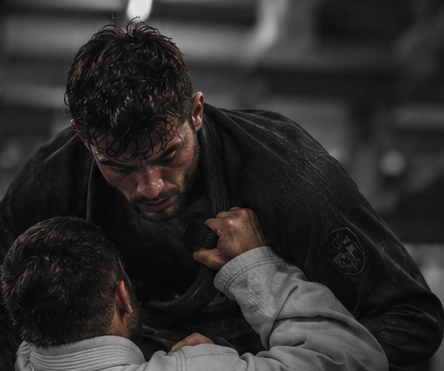
Gassing out is a symptom, not a complete explanation
You control the opening minutes, fight for two grips and attempt a sweep. Suddenly your forearms seize up. Another athlete maintains pressure, recovers between actions and still accelerates late. Conditioning, relative strength, local endurance, technique and strategy may all contribute. Before adding another circuit, work with your coach to identify what usually breaks down first.
1. What BJJ demands of the body
Jiu-jitsu alternates bursts, isometric holds and lower-intensity actions. Andreato and colleagues reviewed 58 studies involving 1,496 participants, highlighting dynamic strength, isometric strength and muscular endurance. The aerobic system helps sustain work and recovery between efforts; anaerobic pathways contribute to accelerations. No single work-to-rest ratio describes every match.[1]
2. Sweating like a match does not mean training the right capacity
Burpees, sprawls, ropes and towel grips can create considerable fatigue. But if grip fails first, it can limit a session intended to challenge cardiovascular fitness. Circuits can also duplicate hard sparring load. This does not make every circuit useless: one study found similar acute responses between a BJJ-specific model and simulated combat. That similarity does not establish long-term superiority. Choose the tool for the capacity you need, not simply the feeling of exhaustion.[6]
3. How to choose the sessions below
Session A — aerobic base, 35 minutes
Use a stationary bike, incline walking or easy running if you already tolerate impact. Rowing is an option but may add grip and lower-back fatigue. Finish feeling you could continue. Beginners can use 5 minutes of warm-up, 10 comfortable minutes and 5 easy minutes: 20 minutes total.
| Step | Dose | Effort / recovery |
|---|---|---|
| Warm up | 5 min | Easy |
| Main work | 25 min | RPE 3–4; full sentences |
| Cool down | 5 min | Very easy |
Session B — hard aerobic intervals, 39 minutes
A 2025 meta-analysis pooled 20 studies in Olympic combat sports and found HIIT benefits for aerobic capacity and power. Reviews from 2020 and 2026 also support it as a tool, without guaranteeing identical transfer to BJJ. Poon’s umbrella review included 24 adult reviews and meta-analyses with varied findings and populations. The example below is a practical proposal, not a protocol proven superior for every fighter.[2][3][4][5]
| Step | Dose | Effort / recovery |
|---|---|---|
| Bike: warm up | 10 min | Build gradually |
| Intervals | 4 × 3 min | RPE 8; repeatable pace |
| Between intervals | 3 × 3 min | Easy pedaling; only between the 4 efforts |
| Cool down | 8 min | Easy |
That is 12 hard minutes and 9 recovery minutes between them: 10 + 12 + 9 + 8 = 39 minutes. Do not start with a sprint. If pace collapses, lower resistance or end the intervals. A gentler introduction is 3 × 2 minutes with 2 easy minutes between efforts. If the week already includes several maximal sparring sessions, replace a hard session rather than adding HIIT.
Session C — quality short bursts
For those already accustomed to hard efforts: warm up for 10 minutes on a bike with progressive accelerations. Perform 2 blocks of 5 × 10 fast seconds, with 70 easy seconds between repetitions. Between blocks, pedal easily for 3 minutes instead of the usual short recovery. Finish with 5 easy minutes. That is 10 efforts and 8 short rests: approximately 29 minutes total. Prioritize speed and control; do not increase resistance until it becomes a slow strength grind.
Start with one block if needed. End the set when speed or technique clearly declines; a longer rest can be better than pushing on. Do not automatically combine B and C. They target different qualities, and both count as hard training.
Session D — general strength, about 40–50 minutes
Greater strength can lower a task’s relative effort, but a deadlift record does not guarantee a better sweep. Warm up for 8–10 minutes with comfortable mobility and light practice sets. Complete each exercise with rest instead of turning everything into a circuit. Keep 2–3 repetitions in reserve; beginners can start with 2 sets per exercise under technical supervision.
| Exercise | Sets × repetitions | Rest between sets |
|---|---|---|
| Goblet squat or a familiar variation | 3 × 5–6 | 2–3 min |
| Chest-supported row | 3 × 6–8 | 2 min |
| Dumbbell Romanian deadlift | 2 × 6–8 | 2 min |
| Push-up or dumbbell bench press | 2 × 6–10 | 90 s |
| Pallof press, each side | 2 × 8–10 | 60 s |
Session E — grip without exhausting your next practice
Choose just one option after strength work, initially once weekly: dumbbell farmer carries for 3 × 20–30 seconds with 60–90 seconds rest; or a towel hold with feet supported for 3 × 15–20 seconds with 60–90 seconds rest. Prepare hands and shoulders with 2 easy trials. Use secure support and manageable loading. Stop before posture or grip fails, and stop for pain, tingling or joint discomfort. Do not place this block before your most important sparring.
4. Short matches, long matches and multiple bouts
Short matches emphasize rapid force production and a controlled start. Longer matches place greater demands on sustained effort and technical economy. Tournaments add recovery, fueling and energy management between bouts. This does not turn match duration into a circuit prescription. Five uninterrupted minutes do not reproduce decisions, leverage or an opponent’s changing resistance.
5. Energy efficiency can also be trained
Ask your coach to watch for unproductive grips, excessive tension and accelerations without advantage. In a technical class, for example, use 3 positional rounds of 2 minutes with 1 minute between them for recovery and feedback: 8 minutes plus initial instruction. The coach selects position, partner and resistance. The goal is appropriate breathing and less unnecessary tension, not winning at any cost. Do not use breath-holding, hyperventilation or oxygen deprivation to build conditioning.
6. A week that respects mat training
An example for someone already accustomed to three weekly classes. HIIT is a planned replacement when needed, not a seventh obligation. If you train BJJ five or six times weekly, there may only be room for one or two additions. No fixed recovery interval suits everyone: monitor sleep, soreness, performance and readiness.
| Day | Priority |
|---|---|
| Monday | Technical BJJ and controlled rounds |
| Tuesday | Strength D; grip E only if recovery allows |
| Wednesday | BJJ with hard rounds |
| Thursday | Aerobic A or rest depending on fatigue |
| Friday | Reduced strength work or rest |
| Saturday | Technical BJJ; B or C only as a coach-planned replacement |
| Sunday | Rest |
7. Six-week progression without rushing to add fatigue
| Period | Practical action |
|---|---|
| 1–2 | Log rounds and RPE; start with a shorter A and one adapted D |
| 3–4 | Maintain or extend A from 20 to 25 minutes if tolerated; assess whether to replace hard work with B or C |
| 5–6 | Progress just one variable and compare performance under similar conditions |
Strength example: when all sets are technically stable with 3 repetitions in reserve, use the smallest available load increase and reassess. In intervals, first aim for consistent pace; do not shorten rest and add repetitions simultaneously. If sparring quality declines across several sessions, review total load. Maintaining or reducing training for a week is also part of the process.
8. How to tell whether conditioning improved
Repeat a familiar task using the same equipment, duration and broadly similar conditions. Compare power or distance, RPE and interval consistency. On the mat, track technique and decision quality in later rounds and recovery between them. Better sparring does not prove a VO₂max increase: partners and strategy vary. A better cardiovascular test does not guarantee better jiu-jitsu either. Discuss the combined information with your coach.
9. Eight mistakes that drain energy
- Treating every round like a championship final.
- Replacing all aerobic base work with maximal circuits.
- Training grip to failure every day.
- Adding HIIT without counting hard rounds.
- Copying match duration without defining the physical goal.
- Ignoring strength and technical economy.
- Cutting weight aggressively and competing dehydrated.
- Treating all fatigue as poor cardio.
10. Recover so you can repeat
Plan meals, water and rest around session duration, climate and individual tolerance. Between matches, choose foods and drinks already tested in training; competition is not the time to try a new strategy. Severe energy restriction and rapid weight cuts can impair health and performance. Hand, shoulder or back pain requires exercise adjustments. Chest pain, fainting, unusual breathlessness or confusion require stopping activity and seeking medical care.
11. Where VETOR fits
VETOR aims to connect goals, sports, history and progression. For a grappler, supplementary training must account for weekly sparring: sometimes the gap is aerobic fitness, sometimes strength, sometimes recovery. Recording what you did and how you responded supports better conversations with your team. That does not mean automatically measuring lactate, diagnosing fatigue, correcting techniques or predicting wins. Useful training has direction and respects context.
VETOR — DON’T GUESS.
Your next round deserves purposeful preparation. Join the waitlist and follow VETOR.
References
- Physical and physiological profiles of BJJ athletesAndreato et al. (2017) · Sports Medicine - Open
- HIIT in Olympic combat sportsYue et al. (2025) · Frontiers in Physiology
- HIIT and cardiorespiratory fitness in adultsPoon et al. (2024) · Scandinavian Journal of Medicine & Science in Sports
- HIIT in combat sports: systematic review and meta-analysisJournal of Strength and Conditioning Research (2020) · 34(3):888–900
- HIIT in martial arts athletesCai et al. (2026) · Frontiers in Nutrition
- BJJ-specific model and simulated match demandsMagno et al. (2022) · Science & Sports
Educational content for adults. Examples do not replace individual assessment and prescription by health and training professionals.