High-performance rucking and hiking: walk better with a backpack and build endurance
Load, pace, hills and recovery: understand what changes when walking with a backpack, explore strength and cardio examples, and adapt a six-week progression to your preparation.
Download on the App Store
Running well does not guarantee the same ease on a trail with a backpack. Two people with similar fitness may respond differently to weight on their backs, descents, uneven footing and hours of travel. Someone who practices progressive hikes is more familiar with this combination. Preparation depends on the task: carrying a given weight for a certain duration, on particular terrain and at a specific pace.
1. Hiking, rucking and military marching: different purposes
| Activity | Purpose | Load and context |
|---|---|---|
| Hiking | Route and outdoor experience | Equipment needed for the trail |
| Rucking | Conditioning through loaded walking | Load adapted to training |
| Military march | Operational requirement | Task-specific weight, pace and equipment |
The activities can overlap without requiring the same program. Spiezia’s narrative review describes how speed, load, slope, duration and task influence military marching demands. Foot, knee and back problems are among the concerns. Applying these principles to recreational hiking requires acknowledging differences in population, equipment and goals.[1]
2. Weight is only part of the difficulty
A backpack increases the mass moved and changes the work of the legs and trunk. But fifteen kilograms does not impose the same demand on everyone, and a percentage of body mass does not measure strength or tolerance. Hudson gathered 33 studies on physiological and biomechanical differences between men and women; several differences diminished after adjustment for physical characteristics. Sex or body mass alone does not define an ideal load.[3]
The same backpack demands more at a faster pace or uphill. Descending requires muscular braking even when heart rate seems controlled. Interpret load, speed, duration and terrain together instead of judging a session only by kilograms carried.
3. Progression: do not increase everything at once
Going from five kilometres with five kilograms to eight kilometres with ten, while trying to walk faster, changes several demands at once. Defense Centers for Public Health guidance recommends gradual marching preparation and separate distance and load increases. References to 10% in military guidance are not a universal safety threshold or proof that smaller increases are always appropriate.[6]
Choose one main variable: longer duration at the same weight, more load on the same route, or hills with other demands reduced. Observe the response during activity and recovery before progressing again. Repeating a well-tolerated session can also be useful.
4. Strength training: general capacity for a specific task
Quadriceps, glutes, calves and trunk help support, move and control the combined mass. Mikkonen’s narrative review describes benefits of strength training, alone or with aerobic work, in military tasks including load carriage. That does not remove the need for backpack familiarization or define the best program for every hiker. For someone already doing strength training, a supplementary example is:[4]
| Exercise | Sets | Repetitions or distance | Rest between sets |
|---|---|---|---|
| Squat | 3 | 5–8 | 2–3 min |
| Romanian deadlift | 3 | 6–10 | 2 min |
| Step-up | 2 | 8 per leg | 90 s |
| Standing calf raise | 3 | 10–15 | 60–90 s |
| Row | 3 | 8–12 | 90 s |
| Farmer carry | 2 | 20–30 metres | 90 s |
Warm up and use ramp-up sets when needed. Choose loads and step heights that allow control, without an obligation to reach failure. Adjust or split volume if the session compromises the next walk. Step-ups share general demands of raising the body but do not perfectly reproduce a trail. Strength develops resources; walking with a backpack teaches their use in the task.
5. Build an aerobic base without loading every session
Unloaded walking, cycling, rowing or running can complement endurance according to ability and goals. A 40 min example at a comfortable effort of roughly 3–4/10:
| Step | Duration |
|---|---|
| Easy warm-up | 5 min |
| Comfortable continuous activity | 30 min |
| Easy cool-down | 5 min |
This subjective scale does not measure a physiological threshold. Machado’s review gathered five studies on knee muscle function after loaded walking and found acute strength reductions in certain protocols; methodological differences prevented meta-analysis. Good cardiovascular fitness does not remove backpack-related muscular fatigue. Other activities complement, but do not fully replace, specific experience.[2]
6. Climbs and descents change the task
Uphill walking increases work against gravity; slower pace or shorter steps may be needed, without a universal cadence. Downhill, muscles brake the body and load and can accumulate fatigue despite moderate pulse. Introduce small slopes first, then familiar routes with elevation changes, without also raising weight. An inclined treadmill can train part of the uphill demand but does not reproduce descents, uneven ground or changing footholds.
7. How to choose a starting load
| Profile | Illustrative starting point |
|---|---|
| No walking experience | Walking without added load |
| Already walks regularly | Very light backpack; around 2–4 kg only if tolerated |
| Intermediate | Load matching previous exposure |
| Advanced or occupational preparation | History and target task, with prior progression |
These are planning examples, not clinically established doses. You do not need to start with four kilograms or carry heavy loads just because you are advanced. Count the backpack, water, food and equipment in total weight. Increase only with good tolerance, controlled execution and adequate recovery; this does not require a weekly increase.
8. Pacing: walk better without turning it into running
Use a familiar load and keep your gait controlled. Running with a backpack should not be the automatic progression for a recreational participant. A 35 min pacing example, without sprinting or a fixed speed requirement:
| Step | Duration |
|---|---|
| Initial comfortable walk | 10 min |
| Faster, controlled walking | 5 min |
| Comfortable recovery walk | 5 min |
| Second faster block | 5 min |
| Final comfortable walk | 10 min |
9. Backpack: fit and stability before bulk
Pack contents stably, close to the body and according to the manufacturer. Adjust shoulder straps and, where available, the hip belt without excessive compression. Pain, numbness and tingling deserve attention. Test the setup in motion: five comfortable minutes do not guarantee comfort after an hour. No model is ideal for every task.
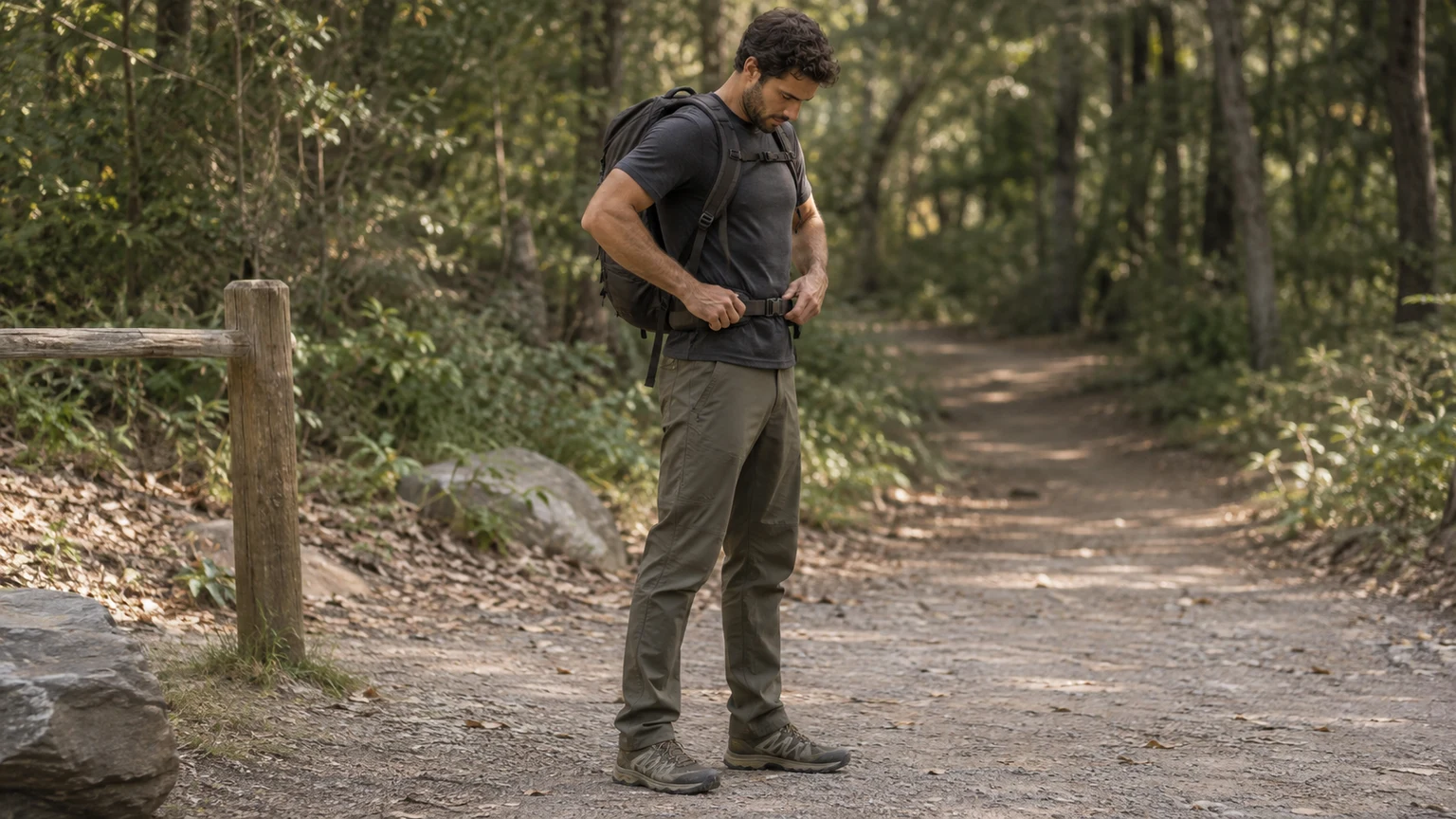
Lundervold compared two systems in 14 participants carrying 16 kg: trunk and pelvic movement changed, without a significant oxygen-consumption difference under the tested conditions. Different design can change mechanics without necessarily reducing energy cost. The photograph is illustrative and does not certify an individual fit.[5]
10. Feet and footwear can limit you before breathing does
Repeated friction, pressure, moisture and movement between skin, socks and shoes contribute to foot problems. Choose suitable size, width and materials; rigid boots are not superior on every trail. Try new gear on short walks first and notice rubbing early. No sock or shoe combination eliminates blisters for everyone. Do not ignore numbness or persistent pain just to finish the distance.
11. Six weeks to introduce the backpack
For someone already tolerating comfortable walking, one specific session per week can introduce load, alongside strength and aerobic work as recovery allows. The table uses total carried weight, including backpack and water. Values are conditional illustrative ceilings, not mandatory targets. In week five, keep flat terrain if increasing weight; if introducing a slope instead, retain the previous load.
| Week | Illustrative total weight | Duration | Terrain |
|---|---|---|---|
| 1 | 0–2 kg, if tolerated | 30 min | Flat |
| 2 | Same load | 35 min | Flat |
| 3 | Up to 3 kg, if well tolerated | 35 min | Flat |
| 4 | Same load | 40 min | Flat |
| 5 | Up to 4 kg, if well tolerated | 40 min | Flat, unchanged |
| 6 | Same load | 45 min | Same familiar route |
12. A week integrating strength, cardio and rucking
| Day | Illustrative session |
|---|---|
| Monday | Leg and trunk strength |
| Tuesday | Comfortable cardio: 30–45 min |
| Wednesday | Rest |
| Thursday | General strength adapted to the next walk |
| Friday | Rest or easy walking |
| Saturday | Progressive rucking |
| Sunday | Rest |
This is a four-session structure for someone already tolerating that frequency, not an obligation for beginners. Adjust lifting before the walk and allow extra recovery after long or heavy sessions. If you also run, count running in total demand; do not add marches as if they were cost-free. Combine stimuli rather than stacking them.
13. Track progress without losing context
Record distance, duration, total weight, average speed, elevation gain and loss, perceived effort, discomfort and environmental conditions. Compare similar routes and loads when evaluating pace. A slower time on harder terrain does not prove fitness loss. Heart rate, when available, describes cardiovascular response but not the entire load on feet, muscles and joints. The task’s cost matters as much as the result.
14. Food, water and environmental safety
Short comfortable walks do not necessarily require carbohydrate during activity; long routes may need practical foods and a supply plan. Water needs depend on duration, heat, humidity and access along the way; overdrinking can also be dangerous. There is no single carbohydrate dose or litres-per-hour rule for every person and trail. Test strategies on shorter outings rather than using an expedition as the first trial.
Check the route, forecast and official alerts; change timing or route when heat, rain, wind or cold compromise conditions. The National Park Service recommends the ten essential systems below, adapted to the activity. Tell someone your route and return time, and do not rely only on a network-connected phone in remote areas.[7]
Ten essential systems for planning your outing
- Navigation; sun protection; extra clothing suited to the weather.
- Lighting; first aid; fire resources where permitted and appropriate.
- Tools and repairs; food; water and treatment; emergency shelter.
15. Seven mistakes that hold back progress
- Adding weight before tolerating walking well.
- Increasing load, speed and distance simultaneously.
- Ignoring strength and relying only on heavy marches.
- Training only on flat ground for a mountain goal.
- Turning every loaded walk into running.
- Ignoring backpack fit, footwear and foot warning signs.
- Using exhaustion as proof of adaptation.
16. The role of VETOR
A first easy hike and a prolonged march with a specified load require different decisions. VETOR’s approach connects goals, history, routine and progression while considering walking, running, cycling and strength together. When time is short or weather prevents an outing, an alternative can preserve part of the stimulus without being a complete equivalent to a loaded route.
Tracking should use data actually available, such as duration, distance, reported load and effort. We do not claim the app calculates exact backpack metabolic cost, measures joint forces or predicts injuries through sensors without implemented and validated features. GPS, elevation and heart rate also have limits. Value lies in supporting coherent decisions rather than automatically adding weight after every easy session.
17. What science does not yet guarantee
Much of the literature involves military populations with loads and goals different from recreation. Narrative reviews are not equivalent to meta-analyses, and five heterogeneous studies do not define a perfect dose. No universal body-weight percentage, single speed or progression guarantees results and freedom from injury. Develop strength, endurance, control and terrain familiarity to carry the required load, not the heaviest possible load every session.
Prepare your next route with VETOR
VETOR is available for iOS on the App Store. Android is coming soon to Google Play. Signing up for updates is optional and is not required to download the app.
References
- Spiezia, Oliva & Maffulli · Loaded Marches: The Military Safe and Effective Tool to Combat Readiness.British Medical Bulletin · 154(1):ldaf005 (2025) · 10.1093/bmb/ldaf005
- Machado et al. · Functional Impairment of Knee Muscles After Walking with Backpack Load: A Systematic Review.Human Movement · 25(2):36–52 (2024) · 10.5114/hm/186689
- Hudson et al. · A Systematic Review of the Physiological and Biomechanical Differences Between Males and Females in Response to Load Carriage During Walking Activities.Applied Ergonomics · 114:104123 (2024) · 10.1016/j.apergo.2023.104123
- Mikkonen et al. · Importance of Strength Training for Sustaining Performance and Health in Military Personnel.BMJ Military Health · 171(5):413–417 (2025) · 10.1136/military-2024-002744
- Lundervold et al. · Altered Trunk-Pelvis Kinematics During Load Carriage with a Compliant Versus a Rigid System.Ergonomics · 68(7):1056–1066 (2025) · 10.1080/00140139.2024.2390125
- Defense Centers for Public Health — Aberdeen · Foot Marching and Load-Carriage Injuries.U.S. Department of Defense
- National Park Service · Ten Essentials.U.S. National Park Service
Educational content for healthy adults; not a substitute for medical assessment, individual programming or technical preparation for mountaineering and occupational tasks. Examples require adaptation. No guarantee of results or injury prevention. Two AI-generated photographic illustrations; they do not certify backpack fit or execution.