High-performance CrossFit: improve your WOD, strength and endurance without exhausting yourself every day
AMRAP, EMOM, For Time or For Quality? Understand what each format can develop, explore sessions with work and recovery times, and give strength, pacing and rest a purpose.
Download on the App Store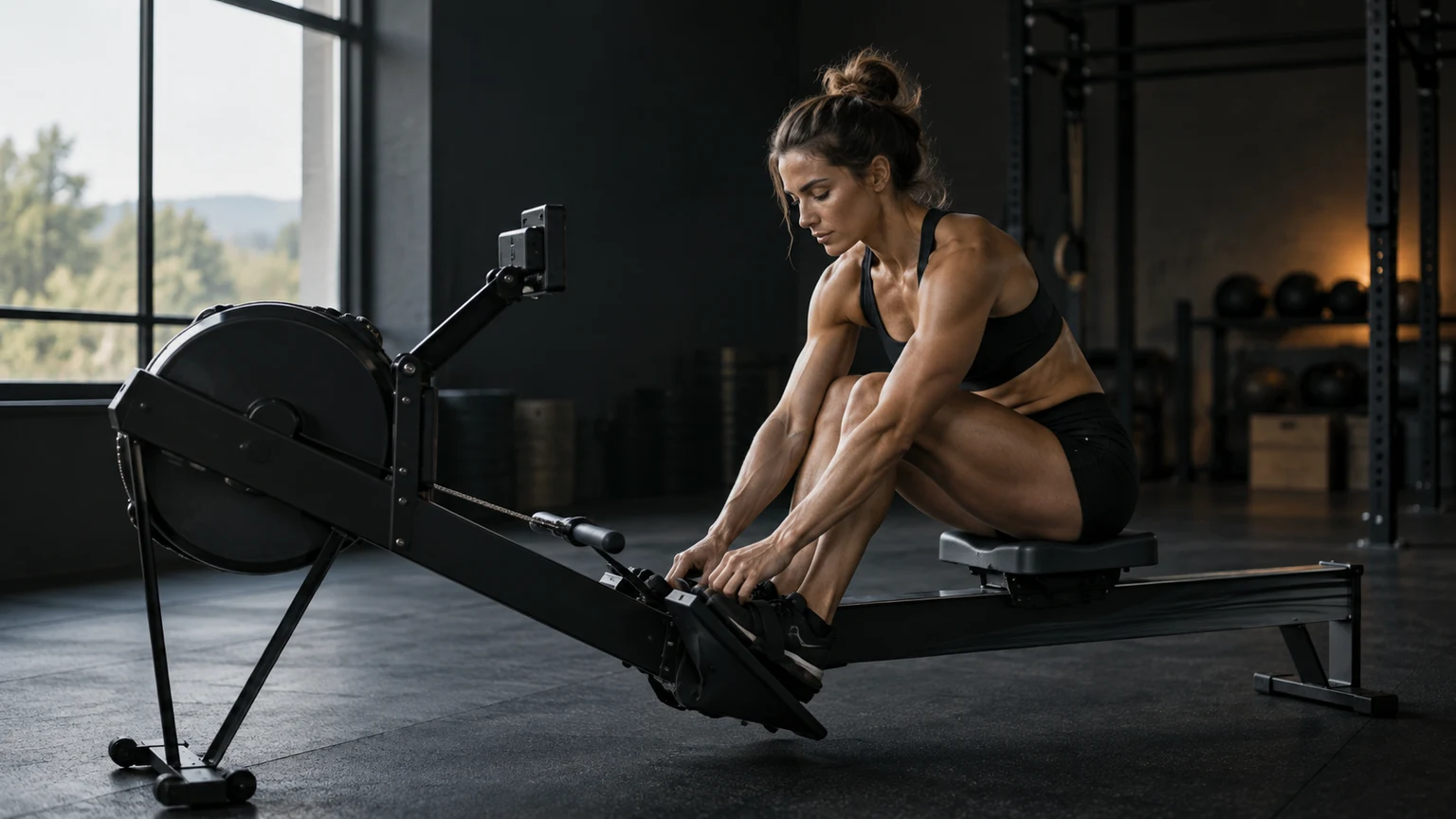
Imagine two athletes with similar experience. One turns every session into a competition: opening AMRAPs at maximum speed, taking strength sets to failure and adding exercises unless completely spent. The other separates strength, aerobic work, technique and hard sessions. We cannot predict who will win the next benchmark, but the second organizes training stimuli instead of using exhaustion as a quality score.
1. What determines CrossFit performance?
A maximal squat, fifteen minutes of sustained work and a gymnastics circuit demand different capacities. Maximal strength helps with heavy loads; power produces work quickly; aerobic endurance supports sustained effort and recovery; muscular endurance allows repeated contractions. Technique, coordination and pacing influence the outcome. Energy systems work together, with contributions changing according to the task.
Malheiro’s review gathered 19 studies and 537 participants on biomechanical and physiological demands. Wang’s meta-analysis included 19 studies and 911 healthy people, finding benefits of HIFT for strength, power, speed, endurance and agility, without a significant flexibility improvement. Protocols varied: this does not show that every WOD develops every capacity or identify an ideal dose for everyone.[1][2]
2. AMRAP, EMOM, For Time and For Quality
| Format | How it works | What to watch out for |
|---|---|---|
| AMRAP | More rounds or repetitions in a fixed time | Sustainable pacing and accumulated work |
| EMOM | Start a task every minute | Remaining time becomes recovery |
| For Time | Finish fixed work in the shortest time | Speed with technical control |
| For Quality | Prioritize execution and consistency | Quality before the score |
In an EMOM, finishing the task in thirty seconds leaves roughly thirty seconds until the next minute; if the task fills the minute, that rest disappears. For Quality describes a priority, not a standardized physiological category. An EMOM can be very demanding and a For Time can use moderate intensity. Exercises, loads, repetitions and rests define the stimulus, not just its name.
3. EMOM versus For Time: what the study found
Smith, Bellissimo and Amorim compared the formats in 12 trained adults with matched exercises and volume. The EMOM lasted 20 min; Rounds For Time took approximately 12 min. Mean heart rate was 153 versus 171 bpm and effort roughly 4/10 versus 7/10, respectively. Post-exercise lactate was 6.5 versus 11.2 mmol/L. These values describe that protocol, not heart-rate targets for the reader.[3]
For Time produced greater acute physiological stress in this experiment. That does not establish superiority for adaptation over months: the sample was small and there was no longitudinal comparison. Rest changes demand even with similar work. Choose the format for the capacity you want to develop and your ability to repeat good sessions, not for which leaves you most tired.
4. Pacing: do not just win the opening minutes
Ribeiro studied 13 male regional competitors in Fight Gone Bad. A controlled start followed by a faster final round better preserved subsequent repetitions and some early neuromuscular measures than an all-out start. This specific protocol does not prove a universal strategy. In longer WODs, planned short pauses and splitting twenty repetitions into two sets of ten may prevent a sharp pace collapse; the movement and athlete matter.[5]
5. The same load does not mean the same effort
A 40 kg bar means something different to someone who can do ten repetitions with 60 kg and someone who can do ten with 100 kg. Barba-Ruíz assessed 25 experienced participants and showed that relative load influences neuromuscular and cardiovascular responses across formats. EMOM showed lower heart rate and velocity loss in some conditions. No single 1RM percentage suits all WODs: adjust weight, complexity and volume to preserve the intended stimulus.[4]
6. Strength: make room for quality sets
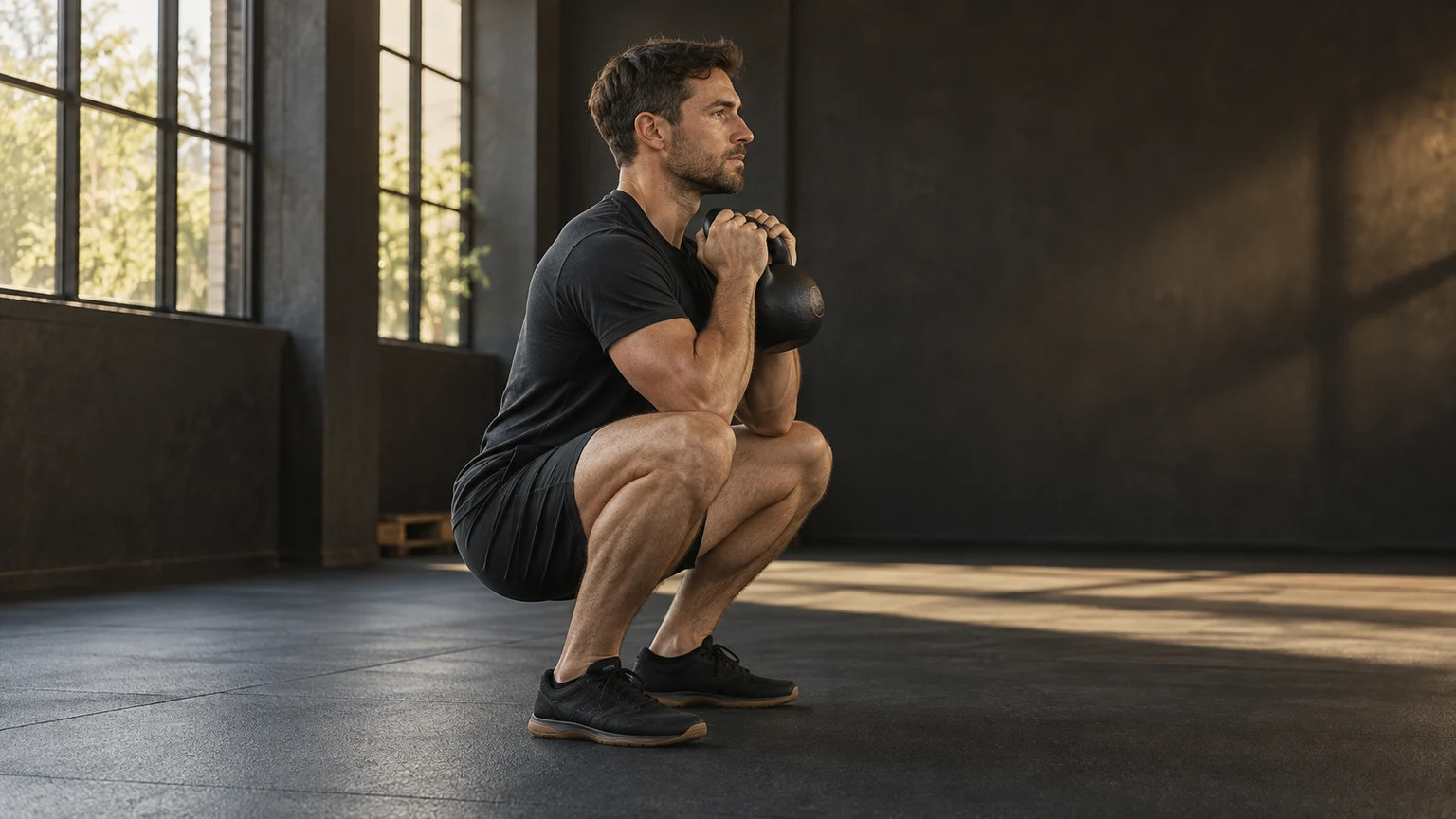
Hundreds of repetitions with moderate loads do not automatically equal specific maximal-strength work. Shorter sets and adequate rests help restore force production. Alternating every heavy squat set with burpees and rowing changes the stimulus. The circuit may be useful, but it follows a different structure. For experienced trainees, one possible session is:
| Exercise | Sets | Repetitions | Rest |
|---|---|---|---|
| Squat | 4 | 4–6 | 2–3 min |
| Romanian deadlift | 3 | 6–8 | 2 min |
| Row | 3 | 8–10 | 90–120 s |
| Trunk exercise | 2 | 30–40 s | 60 s |
Select the load according to experience and execution, without an obligation to fail. Rests are between sets. The table excludes ramp-up sets and need not be added in full to a heavy WOD. If power is the goal, preserve fast movements and quality rather than chasing failure and slowness.
7. Aerobic endurance: easy sessions have a purpose too
Adding two hard circuits to three demanding WODs increases load but does not necessarily solve conditioning. A comfortable continuous session can complement preparation. A 40 min example: 5 min easy, 30 min cycling, rowing or brisk walking at roughly 3–4/10 effort, then 5 min easy. This does not measure an individual threshold. Choose the activity for your capacity and weekly schedule rather than treating every cardio session as a maximal test.
8. Three WODs, three ways to organize work
| Minute | Task |
|---|---|
| 1 | 6–8 goblet squats |
| 2 | 30–40 s on a stationary bike |
| 3 | 6–10 incline or floor push-ups |
Choose one proposal according to the goal and total training load. They need not appear in the same week or follow the full strength session. Record variations, loads and rests: comparing scores with different movements can hide what actually changed.
9. For Quality: learn before speeding up
Learning a clean and repeating it under fatigue are different tasks. A technical block of approximately 15 min might use light front squats (3 × 5), technical hang power cleans (5 × 3) and catch-position practice (3 × 3). Adjust volume to allow sufficient rests and appropriate supervision; use more time or fewer sets if needed. The duration guide must not rush execution. Complex movements require prior competence before racing the clock.
10. Plan the week, not just the WOD
Heavy squats, jumps, intervals, deadlifts and lunges on consecutive days can concentrate substantial demand on the same muscles. This does not predict an injury, but calls for a review of the whole plan. For an intermediate trainee already tolerating four sessions, an illustrative structure is:
| Day | Session |
|---|---|
| Monday | Lower-body strength; short supplementary work if appropriate |
| Tuesday | Comfortable aerobic |
| Wednesday | Rest |
| Thursday | Technique and EMOM with adjusted volume |
| Friday | Rest or easy mobility |
| Saturday | AMRAP or For Time |
| Sunday | Rest |
Beginners may need only two or three sessions; competitors may require a different distribution. Sleep, nutrition, daily work and other sports change available recovery. An easy session still carries load: it is not permission to add unlimited volume.
11. Four-week progression: a framework, not a promise
| Week | Priority | Application |
|---|---|---|
| 1 | Establish reference points | Select loads and record execution, rests and effort |
| 2 | Improve consistency | Maintain technique and reduce excessive pace drops |
| 3 | Adjust one variable | Progress load, repetitions or demand when appropriate |
| 4 | Reassess | Compare the same work under similar conditions |
This is not a validated universal protocol. If six squats in an EMOM allow good execution and about twenty seconds of rest, and become easier, a small load or repetition change may make sense. Both need not change. An improved AMRAP score may also reflect strategy and familiarity. Keep conditions comparable and reassess before making everything harder.
12. Metrics: fatigue is not an adaptation score
Record load, movement variation, repetitions, time, rounds, perceived effort, rests and technical quality. A faster time with less weight is not a direct comparison. High heart rate, sweat or next-day soreness do not demonstrate greater adaptation. Ergometer calories may be an operational work metric rather than an accurate measure of bodily energy expenditure. Interpret trends in context.
13. Injuries and scaling: adapt the task to the athlete
Schlegel assessed 456 Czech participants: 36.4% reported at least one injury in the previous six months. Among reported injuries, spine, shoulders and palms accounted for 30.7%, 28.3% and 14.5%, respectively. These are self-reported cross-sectional data, not proof of causality, a universal probability or a direct safety comparison with other sports. Neither inevitable injury nor guaranteed safety reflects the evidence.[6]
Scaling can adjust load, repetitions, complexity and range of motion as needed. Rows can replace harder pulling movements; step-ups may serve the goal without box jumps. Preserve the session’s purpose without forcing painful positions. Sharp pain, dizziness, disproportionate breathlessness or loss of control warrant stopping and appropriate assessment. An app does not diagnose injuries or replace in-person technical guidance.
14. Adjustments for experience and other sports
Beginners: learn squatting, pulling and pushing with simple variations and controlled time and effort. Intermediates: organize different formats by purpose. Advanced athletes: experience does not remove recovery needs. Runners and combat athletes must include those sessions in the total: a hard leg WOD may affect tomorrow’s run, just as a demanding fight session may affect lifting. Programming should consider the whole person.
15. Where VETOR fits in
Two users can choose CrossFit yet need different stimuli: one has strength but aerobic limitations; the other sustains effort but needs strength and technique. VETOR’s approach connects goals, history, availability and progression. Adapting a session to thirty minutes does not mean cutting every rest. Purpose should guide format, dose and adjustments while accounting for other sports.
Tracking depends on the data actually available. We do not claim that the app automatically measures bar speed, detects errors by camera, diagnoses fatigue or calculates a perfect load without implemented and validated features. Its value lies in organizing training decisions and supporting consistency, with clear limits and professional guidance when needed.
16. What science still cannot guarantee
Reviews include different protocols and populations; acute studies do not demonstrate months of adaptation; small samples limit generalization. No format is universally best and none of these studies establishes a perfect dose. Strength, endurance, technique and recovery must coexist. The best WOD has a demand that makes sense within the process, rather than producing the most fatigue in one day.
Give your next workout a purpose with VETOR
VETOR is available for iOS on the App Store. Android is coming soon to Google Play. Signing up for updates is optional and is not required to download the app.
References
- Malheiro et al. · Biomechanical and Physiological Demands of CrossFit: A Systematic Review.Journal of Human Kinetics · 103:161–183 (2026) · 10.5114/jhk/214743
- Wang et al. · Effects of High-intensity Functional Training on Physical Fitness in Healthy Individuals: A Systematic Review with Meta-analysis.BMC Public Health · 25:528 (2025) · 10.1186/s12889-025-21538-5
- Smith, Bellissimo & Amorim · The Physiological Responses to Volume-matched High-intensity Functional Training Protocols with Varied Time Domains.Frontiers in Physiology · 15:1511961 (2025) · 10.3389/fphys.2024.1511961
- Barba-Ruíz et al. · Acute Neuromuscular and Cardiovascular Effects of Varying Relative Loads in Cross-training Modalities.Frontiers in Physiology · 16:1636752 (2025) · 10.3389/fphys.2025.1636752
- Ribeiro et al. · Fatigue and Performance Rates as Decision-Making Criteria in Pacing Control During CrossFit.Perceptual and Motor Skills · 131(4):1274–1290 (2024) · 10.1177/00315125241247858
- Schlegel, Stuchlíková & Cabrnoch · Epidemiology and Risk Factors of CrossFit-Related Injuries: A Cross-sectional Study Among Athletes in the Czech Republic.Journal of Sports Science and Medicine · 24(4):739–746 (2025) · 10.52082/jssm.2025.739
Educational content for healthy adults. Not a substitute for medical assessment or individual programming. Adapt examples to history, experience and other activities. No guarantee of results or injury prevention. Two illustrative AI-generated images; they do not constitute a technical assessment or endorsement by real people.